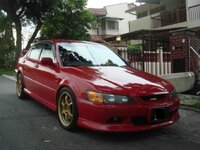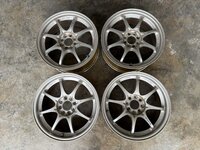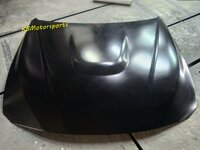
There u go guys.Metric horsepower began in Germany in the 19th century. The various units used to indicate this definition ("PS", "CV", "pk", and "ch") all translate to "horse power" in English, so it is common to see these values referred to as "horsepower" or "hp" in the press releases or media coverage of the German, French, Italian, and Japanese automobile companies. British manufacturers often intermix metric horsepower and mechanical horsepower depending on the origin of the engine in question.
Metric horsepower, as a rule, is defined as 0.73549875 kW, or roughly 98.6% of mechanical horsepower.
PS unit (German: Pferdestärke = horse strength) is no longer a lawful unit, but is still commonly used in Europe, South America and Japan, especially by the automotive and motorcycle industry. It was adopted throughout continental Europe with designations equivalent to the English "horse power", but mathematically different from the British unit. It is defined by the Physikalisch-Technische Bundesanstalt (PTB) in Braunschweig as exactly:
1 PS = 75 kp·m/s = 0.73549875 kW = 0.9863201652997627 hp (SAE)
The PS was adopted by the Deutsches Institut für Normung (DIN) and then by the automotive industry throughout most of Europe. SAE = Society of Automotive Engineers.
Accord CL7 Euro-R, DOHC, K20A ---------> 220PS/8000rpm
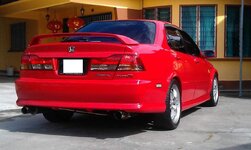
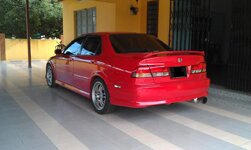
Accord CL1 Euro-R, DOHC, H22A ---------> 220PS/7200rpm
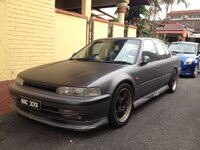
Accord CF4 SiR-T 2.0, DOHC, F20B ------> 200PS/7200rpm
Accord CF4 SiR 2.0, DOHC, F20B ---------> 180PS/7000rpm
Accord CF4 VTS 2.0, SOHC, F20B -------> 150PS/6000rpm
Accord CF3 1.8, SOHC, F18B ------------> 140PS/6100rpm
Accord CF5 2.0 VTS 4WD, SOHC, F20B --> 148PS/6000rpm
Accord CF4 2.0 LEV, SOHC, F20B --------> 145PS/6000rpm
That clears things up. Great write up