
- Joined
- Aug 27, 2004
- Messages
- 1,309
- Points
- 3,148
New 8th Generation Honda Civic
October 21, 2005. 11:45 PM Author: Chips Yap http://www.motortrader.com.my/NUS/articles/0/article_316/startpic.jpg New Civic is larger and longer, with more presence on the road
http://www.motortrader.com.my/NUS/articles/0/article_316/2.jpg Rear end is short but boot space remains generous
http://www.motortrader.com.my/NUS/articles/0/article_316/3.jpg Honda’s designers seem to have been influenced by the Gundam toys (created by Bandai Entertainment) as can be seen from the shapes on the steering wheel and the styling of the headlight apertures (Gundam is a registered trademark of the Sotsu Agency Co Ltd of Japan).
To the Japanese, ‘seven’ is a lucky number the way ‘eight’ is considered lucky to the Chinese. But when Honda launched the seventh generation of the Honda Civic, it seemed to lose some of that flair for which enthusiasts the world over had loved the model for over 30 years. Nevertheless, it was still highly regarded and added substantially to the 16 million units sold worldwide since 1972 (a million of which were sold in Southeast Asia). Now comes the 8th generation of Honda’s original world car and the company is taking the opportunity to demonstrate that the Civic can still be a benchmark model. And should ‘seven’ not have proven good enough, then ‘eight’ might do the trick as this digit is auspicious to the Chinese.
For this new generation, there’s an entirely new look has been given to the Civic with a notable cab-forward design. Though the cabin has been moved forward visually, the rear end has not gained in length and is, in fact, shortened (not quite to a fastback look but still noticeable short). The lines are bolder, giving a stronger presence on the road.
Looking at the styling elements of various sections of the Civic, there might be a sense that the designers were young and grew up playing ‘Gundam’ robots (the Japanese robots which can transform into various configurations). For instance, look at the shape of the headlights – don’t they have some resemblance to the apertures on the head of some Gundams? And when you look inside, you will also find that the steering wheel has the same angular designs which many of the toy robots possess.
When asked about this, a Honda engineer admitted that there was influence from Gundams but did not agree that the designers were young although he said that all Honda engineers are ‘young at heart’ anyway. The styling ideas may appeal to the younger generation of buyers which is no bad thing either.
The Civic has grown dimensionally although this is not an unusual trend for Japanese models that began life as compact entry-level cars. Visually, the new Civic looks bigger with 30+ mm extra length and width but the biggest change is in the wheelbase which has now been stretched to 2700 mm – a whopping 80 mm increase – while the tracks are also significantly wider especially for the rear axle which is now 1525 mm.
Among the highlights of the new generation are the first appearance of the new 1.8-litre i-VTEC engine which is more than just a progression from the 1.7-litre unit. A lot of effort has gone into this new 4-cylinder 16-valve powerplant (still SOHC) and the results are impressive – acceleration that is claimed to be on par with a 2.0-litre engine and fuel economy that is comparable to a 1.5-litre engine at 17 kms per litre. Factory tests have shown that, on average, fuel consumption should be 6% less than for the 1.7-litre engine.
http://www.motortrader.com.my/NUS/articles/0/article_316/4.jpg Larger wipers are fitted now and are also designed to be pedestrian-friendly
http://www.motortrader.com.my/NUS/articles/0/article_316/5.jpg New 1.8-litre i-VTEC engine
http://www.motortrader.com.my/NUS/articles/0/article_316/6.jpg Larger cabin has a premium quality feel with more space front and rear
http://www.motortrader.com.my/NUS/articles/0/article_316/7.jpg New driver-friendly dashboard design with bi-level instrument panel. Note the location of the handbrake lever closer to the driver and requiring less effort to lift
http://www.motortrader.com.my/NUS/articles/0/article_316/8.jpg Digital speedometer is set ahead of the driver, allowing him or her to also see the road ahead while being aware of the speed
The lighter and more compact engine with undersquare dimensions now produces 140 ps of power and 174 Nm of torque, thanks to substantial decreases in internal friction and optimized throttle valve control to significantly reduce pumping losses by up to 16%. Complementing a more efficient valve control system (which retards intake valve closure timing under low-load conditions) is a drive-by-wire system to enable more precise operation of the throttle valve.
Other innovations include a variable-length intake manifold for optimum inertial effect along the intake tract and oil jets for piston cooling which reduce temperatures and allow for a higher compression ratio of 10.5:1 (Japanese-spec) without the risk of engine knock. Whether this means that the engine can run on RON92 petrol in Malaysia remains to be seen, though, but it is likely that the minimum requirement would be RON95.
Needless to say, the new engine runs cleaner too and has the catalytic converter now positioned right next to the engine block where it can heat up very quickly to effectively cleanse the exhaust gases. Honda claims that toxic emission levels are 75% below that set by the 2005 Japanese government standards.
Also new for the powertrain is the 5-speed automatic transmission which is electronically interfaced with the drive-by-wire system and also features direct control via a linear solenoid control system. Apart from having lock-up control in every forward gear (lock-up clutches usually come on only in top gears) , the new transmission also has a number of other innovations which offset the inherent losses of hydraulic drive automatic transmissions. There’s also an ultra-thin torque converter which, with the use of a common driven gear for the top two ratios, makes for more compact overall dimensions.
For those who were hoping Honda would put back double wishbones at the front, no such luck. Chassis configurations typically last two generations anyway so for this generation, the MacPherson struts are still used. Of course, detail changes have been made to improve handling with the aim of providing more linear characteristics. One approach taken has been to increase the castor angle and also the castor trail, both of which have contributed to a 20% increase in aligning toe rigidity.
The trailing arm double wishbone layout at the rear now has separately mounted coil springs and dampers and by positioning them slightly behind the wheel centerline, tyre contact is better. There’s 10% higher rigidity through extending the arm span and the geometry has been tweaked to increase stability under high-load conditions. Where previously the transition from rebound to bump was not linear, this has now been changed to provide a more progressive change.
The suspension improvements are said to have been done without sacrificing ride comfort (although the longer wheelbase already enhances that to some extent). Use of a side force-cancelling spring at the front and the redesign of the spring/damper set-up at the rear have been contributory factors to improving comfort and lowering road noise as well.
With each new generation, you can expect safety standards to rise and the 8th generation is no exception. Honda has used its advanced crash test facilities to re-engineer the new Civic’s front end so that the impact forces of a full frontal collision will be more effectively dissipated around the cabin. Tested against the larger Legend model, the resistance of the new Civic structure appears to be impressive and though not officially tested, there is optimism that the new structure could get 5 stars in the EuroNCAP crash tests.
Previous EuroNCAP crash tests have shown that Honda front ends have been fairly pedestrian-friendly and with the new Civic, there is the same high level of consideration given. The bonnet design has been made more impact-absorbing and even the wiper designs are more flush against the windscreen.
The extended wheelbase mentioned earlier, plus the wider body, mean that the cabin is more spacious and indeed this is clearly evident with the more expansive feeling. This new Civic feels big inside, enhanced by the large windscreen. In fact, the slope of the windscreen is so accentuated that it has been necessary to put a small window at the base of the A-pillar (as in MPVs).
Greater driver-friendliness was a key item in the interior designers’ brief and towards this end, the cockpit area was completely redesigned. There’s now a bi-level layout for the instrument panel with the digital speedometer set some 260 mm ahead of the tachometer (which has a nice graduated background illumination). The positioning of the speedometer at a further point helps in focusing of the eyes but then again, there is the need to move the eyes to two points (the tachometer is closer) at different distances so that means re-focussing of the eyes.
It’s an arrangement that works rather like a Heads-Up Display (HUD) which presents the most important information in the driver’s forward line of sight and which is easier for most people to focus on. Putting a HUD in a car is not new as the first cars had them back in the mid-1980s. But it is still expensive technology and needs to be refined further so for now, Honda’s solution in the Civic seems like a clever way to achieve the same benefits.
The choice of a digital read-out for the speedometer has been debated since digi-graphic instrument panels appeared in the early 1980s. The general feeling from motorists was not that positive and journalists even described the displays as ‘Tokyo by Night’ (a reference to the countless neon signs in the city). Though having a ‘high-tech’ feel, digital displays have been found to give less ‘feel’ of speed changes than analogue meters – the sweep of a needle conveys a better sense of acceleration than just a changing number which is also distracting because it keeps changing. So the manufacturers have generally avoided fitting them and no one has complained.
http://www.motortrader.com.my/NUS/articles/0/article_316/9.jpg New suspension (upper pair) compared with old suspension (lower pair). Basically the same layout as before but with many changes to improve ride and handling.
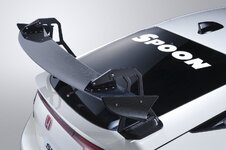
http://www.motortrader.com.my/NUS/articles/0/article_316/10.jpg Dressed-up 8th generation Civic shows the sort of accessories that may be available one day for this new model
Honda, however, says that customer surveys (including some done in Malaysia two years ago) indicated that digital displays are preferred for ‘quicker recognition’ although the designers do not regard it as a definite trend yet. It may be more accepted by the younger generation of buyers who have grown up on computer games which typically have graphic and digital displays and in fact, studies have shown that younger fighter pilots in the US Air Force have been more at ease with the new generation of instrument panels with all the digital and graphic information whereas their older counterparts have found the displays not to their liking.
Other new ideas in the Civic include the positioning of the handbrake lever to the right of the transmission shifter, a location which makes it easier to operate. The important thing is usually the effort needed and the engineers have made it light enough to yank up… women will appreciate it.
A more premium feel permeates the new Civic and little details here will delight customers. As an example, the hinges for the bootlid now have a cover, something which has usually been offered only on more expensive models. The bootlid also has a soft-touch electro-magnetic latch and when lifted, you will find two levers just under the parcel shelf which are to release the rear backrests in a more convenient manner.
On some versions, there is also a reverse camera incorporated in the bootlid. It’s a great feature to have but the high cost (including having a monitor on the dashboard) may prevent Honda Malaysia from offering it in the locally-assembled model.
One small omission I noticed was that there are no slots or depressions in the inside face of the bootlid to pull it down. It’s not something difficult to do as you can shape the trim panel to have something to grip, rather than make people put their hands on the outside surface which will inevitably be dirty. It’s surprising that a Japanese manufacturer would not think of this little detail when the Japanese are well known to be particularly obsessed with cleanliness.
The introduction to the new Civic for Asean journalists included a test-drive session at Honda’s R&D centre in Tochigi, north of Tokyo. There were three different areas to try to cars but the surfaces were all smooth and not really representative of real-world roads. What could be ascertained from the session was the more assertive performance of the new 1.8-ltre engine with a noticeable low-end boost in torque and more fail-safe handling characteristics. Steering response felt more linear too and the assistance was just right to give a good feel of what the front wheels were doing. It’s hard to say more about the other aspects of the car but on paper, it feels like a big improvement over its predecessor.
At this time, Honda Malaysia is not revealing the price nor engine line-up for the locally-assembled version which should be launched during the first quarter of 2006. However, from conversations with various executives, it sounds like the new 1.8-litre engine won’t be the only one available and there is a possibility that the new Civic will also come with the 2.0-litre unit. If nothing else, the company would want the big-engined version to do battle at the Merdeka Millenium Race again!
http://www.motortrader.com.my/NUS/articles/0/article_316/lastpic.jpg The different generations of Honda Civics since the first generation was launched in 1972.
October 21, 2005. 11:45 PM Author: Chips Yap http://www.motortrader.com.my/NUS/articles/0/article_316/startpic.jpg New Civic is larger and longer, with more presence on the road
http://www.motortrader.com.my/NUS/articles/0/article_316/2.jpg Rear end is short but boot space remains generous
http://www.motortrader.com.my/NUS/articles/0/article_316/3.jpg Honda’s designers seem to have been influenced by the Gundam toys (created by Bandai Entertainment) as can be seen from the shapes on the steering wheel and the styling of the headlight apertures (Gundam is a registered trademark of the Sotsu Agency Co Ltd of Japan).
To the Japanese, ‘seven’ is a lucky number the way ‘eight’ is considered lucky to the Chinese. But when Honda launched the seventh generation of the Honda Civic, it seemed to lose some of that flair for which enthusiasts the world over had loved the model for over 30 years. Nevertheless, it was still highly regarded and added substantially to the 16 million units sold worldwide since 1972 (a million of which were sold in Southeast Asia). Now comes the 8th generation of Honda’s original world car and the company is taking the opportunity to demonstrate that the Civic can still be a benchmark model. And should ‘seven’ not have proven good enough, then ‘eight’ might do the trick as this digit is auspicious to the Chinese.
For this new generation, there’s an entirely new look has been given to the Civic with a notable cab-forward design. Though the cabin has been moved forward visually, the rear end has not gained in length and is, in fact, shortened (not quite to a fastback look but still noticeable short). The lines are bolder, giving a stronger presence on the road.
Looking at the styling elements of various sections of the Civic, there might be a sense that the designers were young and grew up playing ‘Gundam’ robots (the Japanese robots which can transform into various configurations). For instance, look at the shape of the headlights – don’t they have some resemblance to the apertures on the head of some Gundams? And when you look inside, you will also find that the steering wheel has the same angular designs which many of the toy robots possess.
When asked about this, a Honda engineer admitted that there was influence from Gundams but did not agree that the designers were young although he said that all Honda engineers are ‘young at heart’ anyway. The styling ideas may appeal to the younger generation of buyers which is no bad thing either.
The Civic has grown dimensionally although this is not an unusual trend for Japanese models that began life as compact entry-level cars. Visually, the new Civic looks bigger with 30+ mm extra length and width but the biggest change is in the wheelbase which has now been stretched to 2700 mm – a whopping 80 mm increase – while the tracks are also significantly wider especially for the rear axle which is now 1525 mm.
Among the highlights of the new generation are the first appearance of the new 1.8-litre i-VTEC engine which is more than just a progression from the 1.7-litre unit. A lot of effort has gone into this new 4-cylinder 16-valve powerplant (still SOHC) and the results are impressive – acceleration that is claimed to be on par with a 2.0-litre engine and fuel economy that is comparable to a 1.5-litre engine at 17 kms per litre. Factory tests have shown that, on average, fuel consumption should be 6% less than for the 1.7-litre engine.
http://www.motortrader.com.my/NUS/articles/0/article_316/4.jpg Larger wipers are fitted now and are also designed to be pedestrian-friendly
http://www.motortrader.com.my/NUS/articles/0/article_316/5.jpg New 1.8-litre i-VTEC engine
http://www.motortrader.com.my/NUS/articles/0/article_316/6.jpg Larger cabin has a premium quality feel with more space front and rear
http://www.motortrader.com.my/NUS/articles/0/article_316/7.jpg New driver-friendly dashboard design with bi-level instrument panel. Note the location of the handbrake lever closer to the driver and requiring less effort to lift
http://www.motortrader.com.my/NUS/articles/0/article_316/8.jpg Digital speedometer is set ahead of the driver, allowing him or her to also see the road ahead while being aware of the speed
The lighter and more compact engine with undersquare dimensions now produces 140 ps of power and 174 Nm of torque, thanks to substantial decreases in internal friction and optimized throttle valve control to significantly reduce pumping losses by up to 16%. Complementing a more efficient valve control system (which retards intake valve closure timing under low-load conditions) is a drive-by-wire system to enable more precise operation of the throttle valve.
Other innovations include a variable-length intake manifold for optimum inertial effect along the intake tract and oil jets for piston cooling which reduce temperatures and allow for a higher compression ratio of 10.5:1 (Japanese-spec) without the risk of engine knock. Whether this means that the engine can run on RON92 petrol in Malaysia remains to be seen, though, but it is likely that the minimum requirement would be RON95.
Needless to say, the new engine runs cleaner too and has the catalytic converter now positioned right next to the engine block where it can heat up very quickly to effectively cleanse the exhaust gases. Honda claims that toxic emission levels are 75% below that set by the 2005 Japanese government standards.
Also new for the powertrain is the 5-speed automatic transmission which is electronically interfaced with the drive-by-wire system and also features direct control via a linear solenoid control system. Apart from having lock-up control in every forward gear (lock-up clutches usually come on only in top gears) , the new transmission also has a number of other innovations which offset the inherent losses of hydraulic drive automatic transmissions. There’s also an ultra-thin torque converter which, with the use of a common driven gear for the top two ratios, makes for more compact overall dimensions.
For those who were hoping Honda would put back double wishbones at the front, no such luck. Chassis configurations typically last two generations anyway so for this generation, the MacPherson struts are still used. Of course, detail changes have been made to improve handling with the aim of providing more linear characteristics. One approach taken has been to increase the castor angle and also the castor trail, both of which have contributed to a 20% increase in aligning toe rigidity.
The trailing arm double wishbone layout at the rear now has separately mounted coil springs and dampers and by positioning them slightly behind the wheel centerline, tyre contact is better. There’s 10% higher rigidity through extending the arm span and the geometry has been tweaked to increase stability under high-load conditions. Where previously the transition from rebound to bump was not linear, this has now been changed to provide a more progressive change.
The suspension improvements are said to have been done without sacrificing ride comfort (although the longer wheelbase already enhances that to some extent). Use of a side force-cancelling spring at the front and the redesign of the spring/damper set-up at the rear have been contributory factors to improving comfort and lowering road noise as well.
With each new generation, you can expect safety standards to rise and the 8th generation is no exception. Honda has used its advanced crash test facilities to re-engineer the new Civic’s front end so that the impact forces of a full frontal collision will be more effectively dissipated around the cabin. Tested against the larger Legend model, the resistance of the new Civic structure appears to be impressive and though not officially tested, there is optimism that the new structure could get 5 stars in the EuroNCAP crash tests.
Previous EuroNCAP crash tests have shown that Honda front ends have been fairly pedestrian-friendly and with the new Civic, there is the same high level of consideration given. The bonnet design has been made more impact-absorbing and even the wiper designs are more flush against the windscreen.
The extended wheelbase mentioned earlier, plus the wider body, mean that the cabin is more spacious and indeed this is clearly evident with the more expansive feeling. This new Civic feels big inside, enhanced by the large windscreen. In fact, the slope of the windscreen is so accentuated that it has been necessary to put a small window at the base of the A-pillar (as in MPVs).
Greater driver-friendliness was a key item in the interior designers’ brief and towards this end, the cockpit area was completely redesigned. There’s now a bi-level layout for the instrument panel with the digital speedometer set some 260 mm ahead of the tachometer (which has a nice graduated background illumination). The positioning of the speedometer at a further point helps in focusing of the eyes but then again, there is the need to move the eyes to two points (the tachometer is closer) at different distances so that means re-focussing of the eyes.
It’s an arrangement that works rather like a Heads-Up Display (HUD) which presents the most important information in the driver’s forward line of sight and which is easier for most people to focus on. Putting a HUD in a car is not new as the first cars had them back in the mid-1980s. But it is still expensive technology and needs to be refined further so for now, Honda’s solution in the Civic seems like a clever way to achieve the same benefits.
The choice of a digital read-out for the speedometer has been debated since digi-graphic instrument panels appeared in the early 1980s. The general feeling from motorists was not that positive and journalists even described the displays as ‘Tokyo by Night’ (a reference to the countless neon signs in the city). Though having a ‘high-tech’ feel, digital displays have been found to give less ‘feel’ of speed changes than analogue meters – the sweep of a needle conveys a better sense of acceleration than just a changing number which is also distracting because it keeps changing. So the manufacturers have generally avoided fitting them and no one has complained.
http://www.motortrader.com.my/NUS/articles/0/article_316/9.jpg New suspension (upper pair) compared with old suspension (lower pair). Basically the same layout as before but with many changes to improve ride and handling.
http://www.motortrader.com.my/NUS/articles/0/article_316/10.jpg Dressed-up 8th generation Civic shows the sort of accessories that may be available one day for this new model
Honda, however, says that customer surveys (including some done in Malaysia two years ago) indicated that digital displays are preferred for ‘quicker recognition’ although the designers do not regard it as a definite trend yet. It may be more accepted by the younger generation of buyers who have grown up on computer games which typically have graphic and digital displays and in fact, studies have shown that younger fighter pilots in the US Air Force have been more at ease with the new generation of instrument panels with all the digital and graphic information whereas their older counterparts have found the displays not to their liking.
Other new ideas in the Civic include the positioning of the handbrake lever to the right of the transmission shifter, a location which makes it easier to operate. The important thing is usually the effort needed and the engineers have made it light enough to yank up… women will appreciate it.
A more premium feel permeates the new Civic and little details here will delight customers. As an example, the hinges for the bootlid now have a cover, something which has usually been offered only on more expensive models. The bootlid also has a soft-touch electro-magnetic latch and when lifted, you will find two levers just under the parcel shelf which are to release the rear backrests in a more convenient manner.
On some versions, there is also a reverse camera incorporated in the bootlid. It’s a great feature to have but the high cost (including having a monitor on the dashboard) may prevent Honda Malaysia from offering it in the locally-assembled model.
One small omission I noticed was that there are no slots or depressions in the inside face of the bootlid to pull it down. It’s not something difficult to do as you can shape the trim panel to have something to grip, rather than make people put their hands on the outside surface which will inevitably be dirty. It’s surprising that a Japanese manufacturer would not think of this little detail when the Japanese are well known to be particularly obsessed with cleanliness.
The introduction to the new Civic for Asean journalists included a test-drive session at Honda’s R&D centre in Tochigi, north of Tokyo. There were three different areas to try to cars but the surfaces were all smooth and not really representative of real-world roads. What could be ascertained from the session was the more assertive performance of the new 1.8-ltre engine with a noticeable low-end boost in torque and more fail-safe handling characteristics. Steering response felt more linear too and the assistance was just right to give a good feel of what the front wheels were doing. It’s hard to say more about the other aspects of the car but on paper, it feels like a big improvement over its predecessor.
At this time, Honda Malaysia is not revealing the price nor engine line-up for the locally-assembled version which should be launched during the first quarter of 2006. However, from conversations with various executives, it sounds like the new 1.8-litre engine won’t be the only one available and there is a possibility that the new Civic will also come with the 2.0-litre unit. If nothing else, the company would want the big-engined version to do battle at the Merdeka Millenium Race again!
http://www.motortrader.com.my/NUS/articles/0/article_316/lastpic.jpg The different generations of Honda Civics since the first generation was launched in 1972.