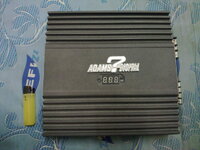
What is DIGITAL AMPLIFIER?

for further detail about the class D is NOT digital,
please check below link:
http://www.caraudiomag.com/specialfeatures/0111cae_anatomy_power_amplifier/index.html
Quote
"Class D
First, let's dispel another myth: Class D does not stand for digital."

That link also provide how many classes are there for ICE and the details for it.
 
Cybertech

so class-D does not stand for digital ka? but hor our sifu Jrd_lee8098 says otherwise wor, how come? how comeleh? :thefinger:
 
NO!!!....
Class A =??? analog??? where got???
Class AB =??? analog...B...??? ape to "B"???
Class D = digital....???

common la.... i'm an electronic engineer in a AV kilang.....
these class is the configuration la.... haiyo....
i provide a famous link for you all to understand ... still dun understand ah???
want me to type in tamil???

then why they want to type digital lagi in "Digital Class D(Digital) Amp" macam bodoh aje.... "Digital Class Digital Amp"....???
 
in my earlier post there are digitally control amp
where amp maybe all variants of classes.
"digital control amp" this case it's still a analog amp but digitally control the audio(analog) signals.
"digital amp" is pure digital from HU to speakers

maybe you mistaken by the term digital and pure digital.
 
Quote from the site (scientific way)
"
Class AB means that the output transistors do not always have current on them. For example, when the upper transistors are pulling up towards the positive rail (pushing the speaker out), there is no current in the lower transistors. When the output signal swings through zero, towards the negative rail, the output transistor must go through a transition from zero current to a non-zero current. The best analogy that I can think of is driving an old car with too much slop in the steering. As you go from one side of the road's crown to the other, the steering crosses a "dead" zone, and you tend to over-steer. Special temperature compensated bias circuitry reduces this dead zone, known as notch distortion. The figure below shows the output of a class AB amplifier with too little bias and the resulting distortion. Notch distortion increases at higher frequencies and low volume levels. Some modern designs have reduced this type of distortion to very low levels.

Class A means that every transistor is always conducting current. They are very similar to class AB amplifiers, but the bias circuitry is set so that there are very high currents in the output transistors. Because these amplifiers do not have this "dead zone', less feedback is required to achieve low distortion.

Class D
First, let's dispel another myth: Class D does not stand for digital. The input is converted to a two-state (binary) representation of the audio waveform. That's where the similarity ends. This distinction is important because class D doesn't provide the benefits normally associated with digital components.

That being said, class D designs dramatically improve efficiency. Instead of wasting power in the output transistor, the output is switched at a very high frequency between the positive and negative supply rails. If the output is to be zero, then the waveform is at a 50% duty cycle. If the output is to be a positive voltage, then the duty cycle would be greater than 50%. Because the output devices are either completely turned on (no wasted voltage) or completely turned off, theoretically efficiency is 100%. So the audio input must be converted to a pulse width modulated waveform (PWM). The yellow trace below is the output of the amplifier; the blue trace is the PWM waveform. The blue waveform is fed to an output filter, which results in the yellow output waveform. Notice that the output looks somewhat distorted. All of the switching noise and distortion cannot be removed and the result can be seen here. Because of this process of converting the input signal to PWM and converting back to analog, a good deal of distortion is introduced. Conventional feedback like that used in class AB designs is used in these amplifiers to reduce distortion.

MOSFETs are the only choice for class D designs. Most class D designs are useful only for bass amps as they can not switch fast enough to reproduce high frequencies. Some high quality, full range class D designs exist for pro audio, but they are complex with multi-phased outputs.
"
 
Sifu cybtech

I donno wor i m oni newbie in ice, u are Super-sifu, u go ask Sifu JRD-loh. I oni know what is Digital meter nia muahahaha :thefinger: :biggrin:

Digital Amplifier has been produced around year 2000. It just have a little of famous company are producing Digital Amplifier....More information to DIGITAL AMPLIFIER, please contact JORDAN 012-5026797
 
Last edited:
Sifu cybtech

I donno wor i m oni newbie in ice, u are Super-sifu, u go ask Sifu JRD-loh. I oni know what is Digital meter nia muahahaha :thefinger: :biggrin:

haha....big big big sifu cybtech already post a details acticle here already...hope you really understand lah!!

cybtech really have a good experience in electronic enginering....he is the true sifu, i'm not sifu lah.....you just call me Jrd_lee "seafood" lah, wakaka.....

mr.cybtech, thank you very much for ur details explanation in my thread, u make us more understanding about it....really thank you very much!

if next time i got problem in "electronic", can i PM u to asking?? Cos i'm learning to make a active crossover by myself....more of theory need to learn from you.:adore: :adore: :adore:
 
haha....big big big sifu cybtech already post a details acticle here already...hope you really understand lah!!

cybtech really have a good experience in electronic enginering....he is the true sifu, i'm not sifu lah.....you just call me Jrd_lee "seafood" lah, wakaka.....

mr.cybtech, thank you very much for ur details explanation in my thread, u make us more understanding about it....really thank you very much!

if next time i got problem in "electronic", can i PM u to asking?? Cos i'm learning to make a active crossover by myself....more of theory need to learn from you.:adore: :adore: :adore:

You're welcome Jrd_lee8098,
Thanks (malu la..."sifu") hehehe....:biggrin:
actually i just apply my AV experience to ICE... the concept is the same....
just that the voltage (power supply) for Home AV is 240V, ICE only 12V...
thats about it.

If you want to diy electronic things for audio/visual... can PM me. (don't la ask to make LCD display or anything super hard to do.... i'll die....):biggrin:
simple-simple one can la....
 
jr lee,i went to your shop last week tinted my car..

maybe this month want to install component set at ur shop...:)

bump for ur nice crew:)
 
jr lee,i went to your shop last week tinted my car..

maybe this month want to install component set at ur shop...:)

bump for ur nice crew:)


thanks for your bump!!!
will recommend a good component to you...
 

Similar threads

Posts refresh every 5 minutes


Search

Online now

Enjoying Zerotohundred?

Log-in for an ad-less experience