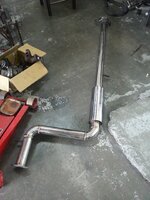
frank i got my answer for diffrence of kompressor and turbo diffrence
Supercharging (aka kompressor (which use by merc) and turbocharging
The term
supercharging technically refers to any pump that forces air into an engine—but in common usage, it refers to pumps that are driven directly by the engine as opposed to turbochargers that are driven by the pressure of the exhaust gases.
Positive displacement superchargers may absorb as much as a third of the total crankshaft power of the engine, and in many applications are less efficient than turbochargers. In applications where engine response and
power is more important than any other consideration, such as
top-fuel dragsters and vehicles used in
tractor pulling competitions, positive displacement superchargers are extremely common. Superchargers are generally the reason why tuned engines have a distinct high-
pitched whine upon acceleration.
There are three main styles of supercharger for automotive use:
- Centrifugal turbochargers—driven from exhaust gases.
- Centrifugal superchargers—driven directly by the engine via a belt-drive.
- Positive displacement pumps—such as the Roots and the Lysholm (Whipple) blowers.
The thermal efficiency, or fraction of the fuel/air energy that is converted to output power, is less with a mechanically driven supercharger than with a turbocharger, because turbochargers are using energy from the exhaust gases that would normally be wasted. For this reason, both the economy and the power of a turbocharged engine are usually better than with superchargers. The main advantage of an engine with a mechanically driven supercharger is better throttle response, as well as the ability to reach full boost pressure instantaneously. With the latest Turbo Charging technology, throttle response on turbocharged cars is nearly as good as with mechanical powered superchargers, but the existing lag time is still considered a major drawback. Especially considering that the vast majority of mechanically driven superchargers are now driven off clutched pulleys, much like an air compressor.
Roots blowers tend to be 40–50% efficient at high boost levels. Centrifugal Superchargers are 70–85% efficient. Lysholm-style blowers can be nearly as efficient as their centrifugal counterparts over a narrow range of load/speed/boost, for which the system must be specifically designed.
Keeping the air that enters the engine cool is an important part of the design of both superchargers and turbochargers. Compressing air makes it hotter—so it is common to use a small radiator called an
intercooler between the pump and the engine to reduce the temperature of the air.
Picking any method of compression that cannot support the mass of airflow needed for the engine creates excessive heat in the air/fuel charge temperatures. This is true with all forms of supercharging. It is critical to not under-size the component.
Turbochargers also suffer (to a greater or lesser extent) from so-called
turbo-spool in which initial acceleration from low RPMs is limited by the lack of sufficient exhaust gas
mass flow (pressure). Once engine RPM is sufficient to start the turbine spinning, there is a rapid increase in power as higher turbo boost causes more exhaust gas production—which spins the turbo yet faster, leading to a belated "surge" of acceleration. This makes the maintenance of smoothly increasing RPM far harder with turbochargers than with belt-driven superchargers which apply boost in direct proportion to the engine RPM.
Turbo-spool is often confused with the term turbo-lag. Turbo-lag refers to how long it takes to spool the turbo up when there is sufficient engine speed to create boost. This is greatly affected by the specifications of the turbocharger. If the turbocharger is too large for the power-band that is desired, needless time will be wasted trying to spool-up the turbocharger.
By correctly choosing a turbocharger, for its use, response time can be improved to the point of being nearly instant. Many well-matched turbochargers can provide boost at cruising speeds. Modern practice is to use two small turbos rather than one larger one, see
Sequential, Twin and Compound turbochargers below.
Centrifugal superchargers suffer from a form of turbo spool. Due to the fact that the impeller speed is directly proportional to the engine RPM, the pressure and flow output at low RPM is limited, thus it is possible for the demand to outweigh the supply and a vacuum is created until the impeller reaches its compression threshold. This is not a great problem for
aero-engines that almost always operate in the top half of their power output, but it is not much help in a car.