why you all still want to put some old engine when the k-series has come.
i have tried it with my uncle Tx3 engine with 2002 lantis V6DOCH(KF)24valve(1995cc.)
Can tapau new 2004 volvo easily and confidently.220++km/h at seremban-kl highway.120km distance with rm15.00 petrol.Make sense for oil cosumption with this engine when lenjan 120km/h-180km/h.What a shock performance and technology.
Mazda has developed new-generation V6 engines. The new V6 series comprises 2.5-litre, 2.0-litre and 1.8-litre engines. The development objective was to ensure high output performance for excellent "acceleration and top-end feel", while satisfying "Clean & Economy" requirements. The engines also had to have a pleasant sound. Mazda selected for these engines a short stroke, 60° V-shaped 24 valve DOHC with an aluminum cylinder block. Various techniques are adopted as follows:
· Combustion improvement and optimization of control to achieve high fuel economy and low emissions
· Improvement of volumetric efficiency, inertia reduction of rotating parts and optimization of control to achieve excellent "acceleration and top-end feel"
· Adoption of a high-rigidity, two-piece cylinder block and crankshaft and weight reduction of reciprocating parts to achieve a pleasant engine sound
· Material changes and elimination of dead space to achieve a compact, lightweight engine
INTRODUCTION
These days, people are not as concerned with material wealth as they are with spiritual wealth. As for automobiles, there is a growing demand for a vehicle which can be deeply satisfying to drive and is environmentally safe (low emission and high fuel economy). V6 engines are becoming popular for their smooth and quiet characteristics. However, in the "family-use" and "compact-speciality" car classes, conventional V6 engines can not meet the lightweight, compact and pleasant drive requirements. Newly developed K-series engines are small, matching stylish and compact vehicles and appeals to the customer's sensitivity and is pleasant to drive. The K-series comprise 2.5-litre V6DOHC(KL), 2.0-litre V6DOHC(KF) and 1.8-litre V6DOHC(K8) engines.
Table 1 Engine specifications
KL KF K8
Type Gasoline, 4-cycle < -- < --
No. of Cyl. & Arrangement 6 cylinders, 60° V type < -- < --
Displacement (cc) 2497 1995 1845
Bore x Stroke (mm) 84.5x74.2 78x69.6 75x69.6
Valve Mechanism DOHC Belt-driven < -- < --
Valves/Cyl. 4 < -- < --
Combustion Chamber Pentroof < -- < --
Compression Ratio 9.2 9.5 9.2
Max. Output (kW/rpm) 123/5600 104/6000 97/6500
Max. Torque (N · m/rpm) 221/4800 170/5000 156/4500
Fuel System EGI < -- < --
Dimensions (L x W x H)(mm) 620x675x640 650x685x660 650x685x655
The K-series engines described in this paper are mounted in the new Mazda 626, MX-6 and MX-3 vehicles. The authors are quite confident that the various development objectives required to these vehicles have been achieved at a high level, making use of the above techniques. The following four points summarize the accomplishments made in developing the K-series engines.
1. K-series engines have achieved low fuel consumption and low emissions by adopting a compact, high-squish combustion chamber and optimizing all controls by microcomputer.
2. High smooth vehicle acceleration characteristics that give excellent "acceleration and top-end feel" have been gained because of two improvements: a compact design that makes full use of intake and exhaust dynamic effect; and an engine control system that optimizes ignition timing.
3. With a more rigid cylinder block and a more rigid crankshaft support structure, low-frequency noise was reduced and rumbling noise suppressed, resulting in a pleasant engine sound.
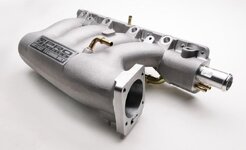
4. A design that aimed for reduced weight and compactness, realized by such modifications as an aluminum cylinder block and an integrated surge tank/inlet manifold, has made the K-series engines the lightest and most compact in the same displacement class of V6 engines, thus contributing to improve fuel consumption and realize a lower hood styling.
i have tried it with my uncle Tx3 engine with 2002 lantis V6DOCH(KF)24valve(1995cc.)
Can tapau new 2004 volvo easily and confidently.220++km/h at seremban-kl highway.120km distance with rm15.00 petrol.Make sense for oil cosumption with this engine when lenjan 120km/h-180km/h.What a shock performance and technology.
Mazda has developed new-generation V6 engines. The new V6 series comprises 2.5-litre, 2.0-litre and 1.8-litre engines. The development objective was to ensure high output performance for excellent "acceleration and top-end feel", while satisfying "Clean & Economy" requirements. The engines also had to have a pleasant sound. Mazda selected for these engines a short stroke, 60° V-shaped 24 valve DOHC with an aluminum cylinder block. Various techniques are adopted as follows:
· Combustion improvement and optimization of control to achieve high fuel economy and low emissions
· Improvement of volumetric efficiency, inertia reduction of rotating parts and optimization of control to achieve excellent "acceleration and top-end feel"
· Adoption of a high-rigidity, two-piece cylinder block and crankshaft and weight reduction of reciprocating parts to achieve a pleasant engine sound
· Material changes and elimination of dead space to achieve a compact, lightweight engine
INTRODUCTION
These days, people are not as concerned with material wealth as they are with spiritual wealth. As for automobiles, there is a growing demand for a vehicle which can be deeply satisfying to drive and is environmentally safe (low emission and high fuel economy). V6 engines are becoming popular for their smooth and quiet characteristics. However, in the "family-use" and "compact-speciality" car classes, conventional V6 engines can not meet the lightweight, compact and pleasant drive requirements. Newly developed K-series engines are small, matching stylish and compact vehicles and appeals to the customer's sensitivity and is pleasant to drive. The K-series comprise 2.5-litre V6DOHC(KL), 2.0-litre V6DOHC(KF) and 1.8-litre V6DOHC(K8) engines.
Table 1 Engine specifications
KL KF K8
Type Gasoline, 4-cycle < -- < --
No. of Cyl. & Arrangement 6 cylinders, 60° V type < -- < --
Displacement (cc) 2497 1995 1845
Bore x Stroke (mm) 84.5x74.2 78x69.6 75x69.6
Valve Mechanism DOHC Belt-driven < -- < --
Valves/Cyl. 4 < -- < --
Combustion Chamber Pentroof < -- < --
Compression Ratio 9.2 9.5 9.2
Max. Output (kW/rpm) 123/5600 104/6000 97/6500
Max. Torque (N · m/rpm) 221/4800 170/5000 156/4500
Fuel System EGI < -- < --
Dimensions (L x W x H)(mm) 620x675x640 650x685x660 650x685x655
The K-series engines described in this paper are mounted in the new Mazda 626, MX-6 and MX-3 vehicles. The authors are quite confident that the various development objectives required to these vehicles have been achieved at a high level, making use of the above techniques. The following four points summarize the accomplishments made in developing the K-series engines.
1. K-series engines have achieved low fuel consumption and low emissions by adopting a compact, high-squish combustion chamber and optimizing all controls by microcomputer.
2. High smooth vehicle acceleration characteristics that give excellent "acceleration and top-end feel" have been gained because of two improvements: a compact design that makes full use of intake and exhaust dynamic effect; and an engine control system that optimizes ignition timing.
3. With a more rigid cylinder block and a more rigid crankshaft support structure, low-frequency noise was reduced and rumbling noise suppressed, resulting in a pleasant engine sound.
4. A design that aimed for reduced weight and compactness, realized by such modifications as an aluminum cylinder block and an integrated surge tank/inlet manifold, has made the K-series engines the lightest and most compact in the same displacement class of V6 engines, thus contributing to improve fuel consumption and realize a lower hood styling.