Acetone as a fuel saver

babahni

Junior Member
Senior Member
Joined
May 10, 2005
Messages
13
Points
3,001
Location
ipoh
Dear friends,
The petrol price has rise again . Anybobody ever tested using acetone as a kind of fuel saver . Here an article about it . It quote :
Significantly Improved Mileage:
This article about acetone (CH3COCH3) probably draws conclusions that Big Oil and the American Car Manufacturers and others do NOT want you to know. They suffer from unlimited corporate GREED. They want bad mileage. The worse, the better as far as they are concerned. Acetone is a vaporization additive rather than a fuel additive per se. It is successful in very tiny amounts from about one part per 5000 to one part per 500. Mileage seems to taper off while HC emissions actually are greatly reduced with too much acetone. The peak gain in mileage comes between .03 of one-percent and .20 of one-percent acetone, depending on the actual vehicle which may be running gasoline or diesel. Note .781 cc per liter or .78 parts per 1000 or one part per 1280 are the same as one ounce per 10 gallons. Acetone operates on the unburned portion of the fuel to gain added vaporization and improved combustion efficiency. Acetone further operates like an electron absorber. There are no bad effects whatsoever and every good reason to use acetone in your fuel. The fuel characteristics during combustion remain those of the original fuel. It just burns more completely with insignificant amounts of acetone.
Details can be read at :
http://pesn.com/2005/03/17/6900069_Acetone/

By the way where in Malaysia could be buy this acetone ?
 
From the same page, which is exactly what i wanted to say:

Acetone and Your Engine

Acetone is known to deteriorate cheap plastics and other substances. While the components in a car's fuel system should be of high quality, and thus immune to any deleterious effects from exposure to acetone, be aware that "ideal" is not always the case in practice. Be advised that not all systems have been tested against acetone. Until such thorough testing has been accomplished and certified by a accredited authority, you assume your own liability for experimentally testing acetone in your particular system.
 
Acetone pro and con

Yes there are pro and con about this subject ,
I quote the con one ;
Acetone is an extremely AGGRESSIVE solvent.

As mentioned above it ate right through a plastic cap that someone was using to measure it out.

Certain part within the engine system may NOT be acetone tolerant if one uses it continuously.

In other words the Acetone could do exactly as the article says ... but at the same time be destroying engine parts that will cost more to replace than the money saved on the fuel.

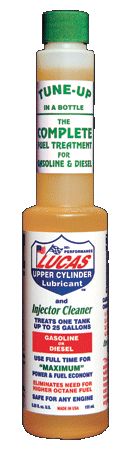
One thing to be checked is that elsewhere some have reported that some fuel additives have Acetone as an ingredient (Fuel System Cleaners?) but I have not been to the auto parts store to look at the labels and verify. This makes sense because of the VERY AGGRESSIVE solvent nature of acetone ... but that aggressiveness that would help it to clean out the fuel system is not necessarily something that you want in your tank for every tankful (the website recommends only adding it every other tank full).

I am curious to see how people´s experience is ... but I´ll let others do the real world testing before I start dumping it in my tank since I am not very anxious to be be replacing parts like fuel pumps, injector pumps and even injectors ... things taht may not be long term Acetone tolerant.

Now the pro one :
acetone is a solvent, not a corrosive liquid. Though it reacts with some plastics, most plastics are made with petroleum.

1. Is unleaded fuel a petroleum product?

Yes

2. Does acetone reduce the surface tension of unleaded fuel, which is a petroleum product?

From LaPointes´ research, Yes.

3. Are plastics made from petroleum products.

Yes

4. Would it be so wrong to expect that acetone would reduce the surface tension of some plastics causing them to "appear" like they melted, when in all actually acetone reduced the surface tension of another petroleum product.

No, it would not be wrong to expect this.

5. Does this mean acetone eats through metal?

Absolutely not.

6. Do motor oils contain detergents and solvents that break down sludge and varnish in an engine, and do not harm the moving metal parts?

All this articles can be read at :
http://www.godlikeproductions.com/b...&topic=3&message=89836&mpage=&showdate=5/7/05
 
so how is this acetone used? we mix into our petrol or just use it purely??

and also de ethanol?
 
after reading the whole article... i find this acetone thingy might work. Aceton is known to be quick in vapourizing. If we add it to our gasoline/petrol it might as well change to become vapourizing. Coz it make the surface tension less.
I dun think etanol can make the job coz etanol is also a kind of alchohol that might not improve the FC but might harm engine body.

To use acetone, we need to add 1 part acetone to 5000 part of pretrol.
I'll try it on my motor 1st.. if anything happen i can overhaul the caburetor myself that is simple job. keke.. :p

There is another myth i came across in internet, ppl say that adding moth ball( ubat gegat) can increase power. I m not sure bout this anyone got any idea? I heard it can increase the octane number. but this doubt me.. :confused:
 
how to use acetone

Mix in the petrol , rate recomended are

Note: .781 cc per liter or .78 parts per 1000

or 7.81 cc for every 10 litres of petrol

very small amount only :D

but another articles recomend :
2.5 ml per litre or 25 ml for every 10 litres
http://www.lubedev.com/smartgas/faq.htm
 
Last edited:
Acetone versus Alcohol (Ethanol/Methanol) usage

Acetone in contrast with Alcohol

In contrast, alcohol has been shown to be corrosive in an engine, yet they put THAT into gasoline. Alcohol in general is anti-mileage. Alcohol is no good in fuels. In Brazil, millions of engines and fuel systems were ruined by alcohol. Yet they are talking of doubling the amount of alcohol in gasoline.

Furthermore, alcohol increases surface tension, producing the opposite effect from acetone. Alcohol in fuel attracts water. This hurts mileage because water acts like a fire extinguisher. Some cars may run badly and even quit due to the incombustible nature of the water-laden fuel. We know of a dozen cars that recently stopped running due to water in the alcohol and gas mixture. In my Neon, it frequently has cut the MPG in half on trips when I take pot luck at the pump.
http://pesn.com/2005/03/17/6900069_Acetone/
http://www.lubedev.com/smartgas/additive.htm
 
ethanol is good man... it helps to complete combustion. It also give you the feel of an octane booster. I've used it when i was in college(Never had enough of $$ for petrol). I had about a few litres with me coz i 'borrowed' the whole drum of pure ethanol from my high school last time kekekee

So ratio was about 1:40 or something like that... Gave me about 20% increase in mileage hahaha... But dunno about the side effects tho... Sold the car already
 
Ethonal is actually good inside the engine. In fact, in the US where Petroleum is really expensive, they used E85 petrol... Which is 85% Ethonal and 15% unleaded Petrol. The result, 102 octane feul. Very clean and powerful that it's even used in Nascar racing.

Read all about it!!
http://www.eere.energy.gov/afdc/e85toolkit/e85_fuel.html
http://en.wikipedia.org/wiki/Alcohol_fuel
 
Last edited:
n305er said:
Ethonal is actually good inside the engine. In fact, in the US where Petroleum is really expensive, they used E85 petrol... Which is 85% Ethonal and 15% unleaded Petrol. The result, 102 octane feul. Very clean and powerful that it's even used in Nascar racing.

Read all about it!!
http://www.eere.energy.gov/afdc/e85toolkit/e85_fuel.html
http://en.wikipedia.org/wiki/Alcohol_fuel

But, in M'sia, Ethanol is much more expensive than petrol. 95% Ethanol + 5% Methanol is cheap (not more than RM20 per 2.5L) but it's corrosive to aluminum parts and it's poisonous to human. 99++% ethanol is about RM98 per 2.5 liter.

**Price are not confirmed, correct if my memory serves me right.
 
Drex: True that ethanol is far way more expensive than petrol here... But if buy in bulk its cheaper. Coz, ethanol is made of synthetic material and petrol is processed from organic. (But please do correct me if im wrong here)

I tried asking from a supplier the last time and the cheapest was about RM4-RM5 / litre. So i dropped the whole idea. I din know that the small drum that i "borrowed" from my school chem lab last time was so valuable... hehehe
 
drexchan said:
But, in M'sia, Ethanol is much more expensive than petrol. 95% Ethanol + 5% Methanol is cheap (not more than RM20 per 2.5L) but it's corrosive to aluminum parts and it's poisonous to human. 99++% ethanol is about RM98 per 2.5 liter.

**Price are not confirmed, correct if my memory serves me right.
Yes. In the US, it's also very expensive at first... but because of the real usefulnes of it.. And because it's proven to be good (not harmful to engines) by major petroleum company and government, it's become a second type of feul in the US.. You only need to make minor modifications to your engine and it's not harmful to humans after it's burnt. It's even safer and cleaner then normal feul... But before it's burnt, and if it vaporise, it's poisonus... Just like normal petrol as well..

Because of all the reasons above, there is much demand in the US and other europe countries. Therefore, there are big factories making ethonal and it's a lot cheaper with such a big demand.

besides, even people with their own beer making stills at home can make ethonal cheaply... :)

In Malaysia... nah... it's another matter...

But all I want to say is that there's no point in saying that Ethonal is bad for the engine... it's already majorly used by Millions of cars and billions of users... making it a multi billion dollar business.. And just imagine, RON102... better then Vpower! :D

As for Acetone, I've never heard of it before... it might be better, or otherwise...
 
Last edited:
n305er said:
Ethonal is actually good inside the engine. In fact, in the US where Petroleum is really expensive, they used E85 petrol... Which is 85% Ethonal and 15% unleaded Petrol. The result, 102 octane feul. Very clean and powerful that it's even used in Nascar racing.

Read all about it!!
http://www.eere.energy.gov/afdc/e85toolkit/e85_fuel.html
http://en.wikipedia.org/wiki/Alcohol_fuel


But did u know thet the high actane feul can burn ur engin the cilinder head gasket...Because high octane feul has a very high tempreture.. My friend did ones and after thet he had to overhole his engin...
And its not cheap..
 
Victa said:
But did u know thet the high actane feul can burn ur engin the cilinder head gasket...Because high octane feul has a very high tempreture.. My friend did ones and after thet he had to overhole his engin...
And its not cheap..
Not sure... but ethanol's temp is only 425°C... And engines can go way higher then that. it's not recomended for old engines that's for sure. newer engines are deisgned for feuls like these.
 
most ethanol are produced from fermentation of biomass, followed by distillation, dehydration, etc.
 
if Im not mistaken last time someone mentioned to put "moth balls" or "ubat lipas" then put it into ur tank to give boost and power, issit have any connection to save fuel?
 
extracted from the website:

Add in tiny amounts from about one part per 5000 to one part per 3000, depending on the vehicle -- just a few ounces per ten gallons of gas. This comes to between 0.0003 % to 0.0025 % acetone maximum or approximately 1/15th of one-percent. Note that is around 0.78 cc per liter or one ounce per 10 gallons. Not more than three oz. per 10 gallons.

This is totally confusing as the values given are contradicting each other.

statement 1 says: "one part per 5000 to one part per 3000"
1/5000 to 1/3000
= 0.02% to 0.03%
= 0.20ml/L to 0.34ml/L

statement 2 says: "0.0003 % to 0.0025 %"

0.0003% v/v to 0.0025% v/v
= 0.003ml/L to 0.025ml/L

the value range way too small to be measurable even with a microlit pipette!! The value is also way too small compared to statement 1.

statement 3 says: "0.78 cc per liter". (note: cc = cubic centimeter = mL)

0.78 ml/L = 0.08%

the value is way too large compared to statements 1 and 2.

statement 4 says: "not more than three oz. per 10 gallons"

3 oz (US) = 88.7 mL
10 gal (US) = 37.854 L

3 oz/10 gal = 2.34ml/L or 0.23%

statement 4 is however comparable to the graph:
http://pesn.com/2005/03/17/6900069_Acetone/images/acetone.jpg

So which one is the correct value?!

statement 1 do not match any of the following statements and the graph-- OUT
statement 2 is not logical -- OUT
statement 3 do not match any of the following statements and the graph -- OUT
statement 4 matches the graph. Well, definitely i can't say that two false make a right. But these two data are the only matched pair.

OK. I did my experiment using the value given in statement 4 and the plots in the graph.
 
Last edited:

Similar threads

Posts refresh every 5 minutes


Search

Online now

Enjoying Zerotohundred?

Log-in for an ad-less experience