Tufoil Review

  • Thread starter Tom
  • Start date
  • Replies 21
  • Views 26K
T

Tom

Guest


Welcome to one of automotive performance best kept secrets. The oil additive.


Most oil additive claims to make your engine run cooler, smoother, quieter
and therefore producing more power. PTFE or Teflon by DuPont is one of the main
slippery stuff.


What's Tufoil:
  • The World's most Efficient Lubricant as claimed in the Guinness Book of
    World Records
  • A invention by an award winning inventor, Franklin Reick
  • The Most slippery substance known to man
  • A super-suspension of micro-miniature PTFE particles and soluble
    Molybdenum, permanently suspended in oil
  • Gives engines super acceleration, easier starts, smoother engine
    performance and better fuel mileage
  • Produces the lowest friction and wear of any known lubricant as tested
    by the U. S. Government
  • The most effective way to reduce internal friction and wear in your
    engine


About PTFE/Teflon in Tufoil
[/LIST]


By Tufoil,


"Tufoil is a precisely formulated blend of synthetic and mineral oils with
electro statically charged sub micron particles of PTFE (polytetrafluoroethylene)
and soluble molybdenum compounds suspended in and dispersed throughout the
carrier. This additive mixes with both mineral and synthetic oils to provide the
very best in protection from frictional wear and high temperatures. While there
are those who may doubt the effectiveness of the Teflon inside the product we
have an excellent analogy. Four households were each given the ingredients to
make a chocolate cake but after baking only one came out tasting perfect yet
they all had the same ingredients. The answer lies in how the ingredients were
mixed and with the technical knowledge of the maker to create a perfect product.
The manufacturers of Tufoil have a unique worldwide patented process, which
provides a way to incorporate the Teflon into the product to make it the best
additive available. Tufoil's PTFE suspension works itself deep in to the most
limited contact areas unaffected by other lubricants. The micron size of these
particles ranges between .02 and .5 microns so Tufoil will not clog filters or
oil openings.
http://www.qualityimports.co.nz/tufoil/tufoil_guinness.htm, which is more slippery than Teflon itself."
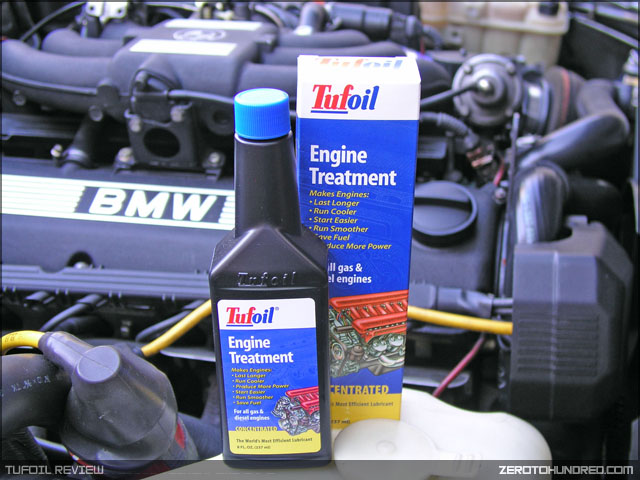


tufoilpose.jpg


Special thanks to:


[/LIST]


Test car:

1989 BMW E30 325i.


Review Starts:

[Date] September 10 2004

[Process]
  • An oil service was done
  • Oil Filter replaced
  • Spark plugs replaced
  • Air filter cleaned


[Date] September 17 2004 (1 week later):

[Process]
[/LIST]

  • Car was driven to Visworks autolab (www.visauto.net)
  • The car was then tested on the dyno.
  • Power was recorded (Graphs bottom of the article)
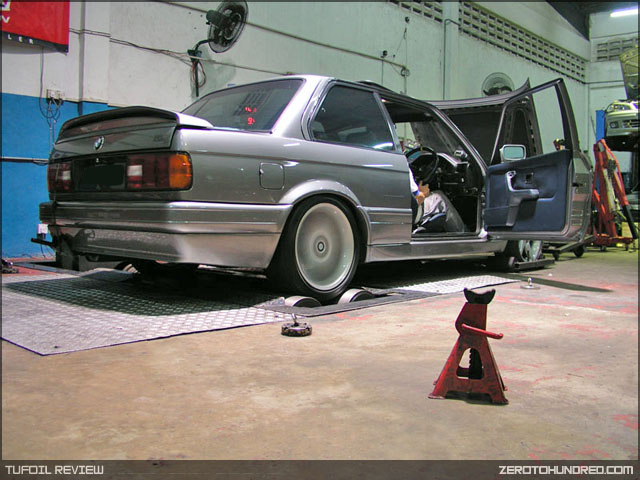

tufoildyno.jpg


[/LIST]


[Date] September 18 2004

[Process]
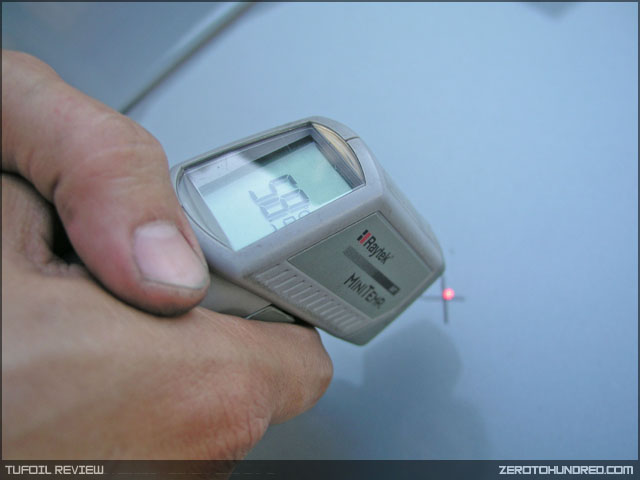
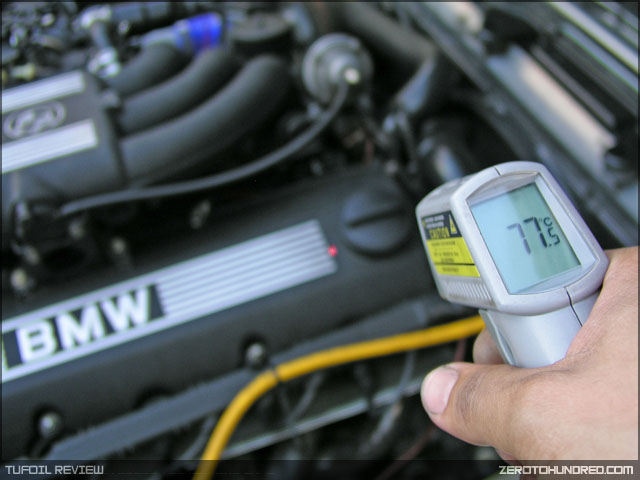
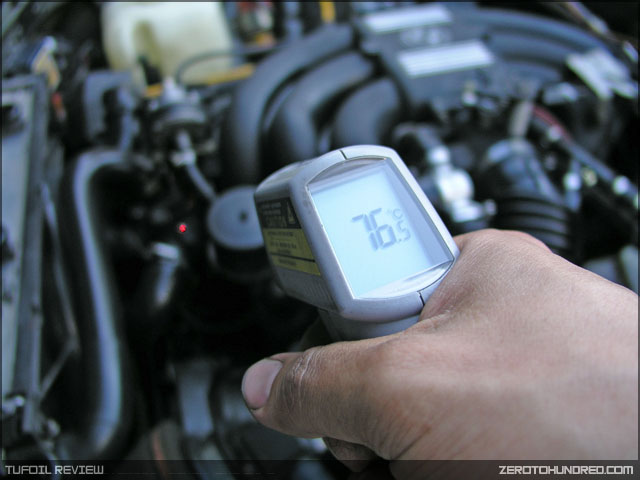
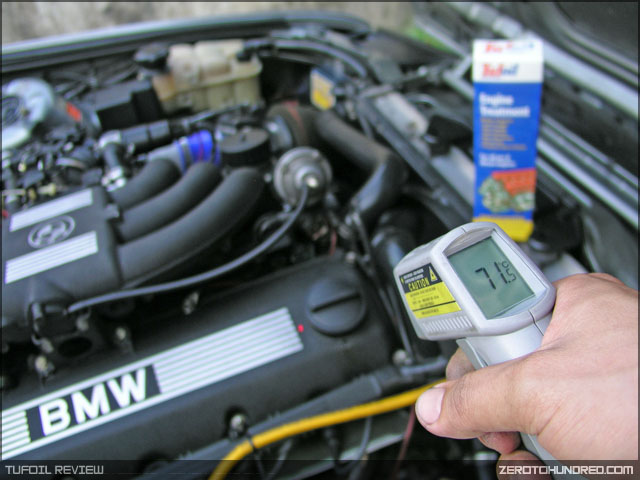
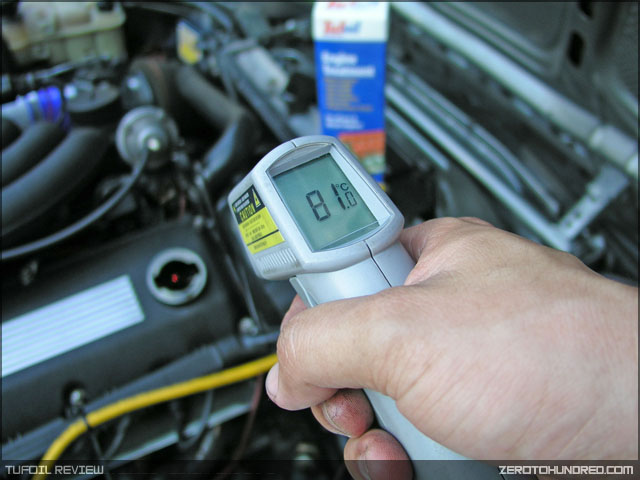
  • After leaving the engine to idle for 5minutes, then, while
    idling, temperature was taken (positions marked and distance between the gun
    noted) at the:
  • Bonnet : 58.5oc


  • Engine Head Cover: 77.5oc


  • Tappets: 85.5oc


  • Water hose from the engine: 76.5oc


  • Engine Shut off


[Date] September 19 2004 (1 day later)

[Process]
[/LIST]

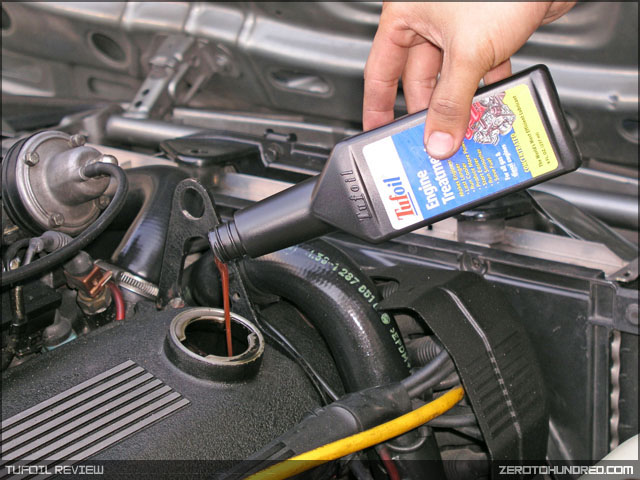
  • 1 bottle of Tufoil was poured in


  • The engine then was started and while running, the engine noises
    typically the tappets significantly decreased every second
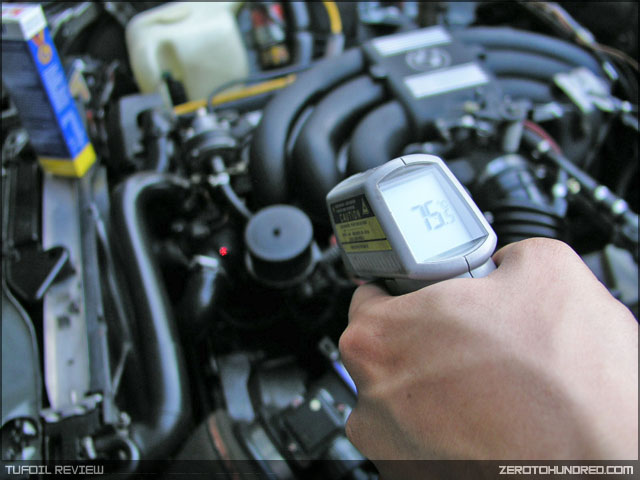
  • After leaving the engine to idle for 5minutes, then, while idling,
    temperature was taken at the:
  • Bonnet: 55.0oc


  • Engine Head Cover: 71.5oc


  • Tappets: 81.0oc


  • Water hose from the engine: 75.5oc


[Date] September 26 (1 week later)

[Process]
[/LIST]

  • The car was then sent for a dyno test


tufoildyno2.jpg

[/LIST]

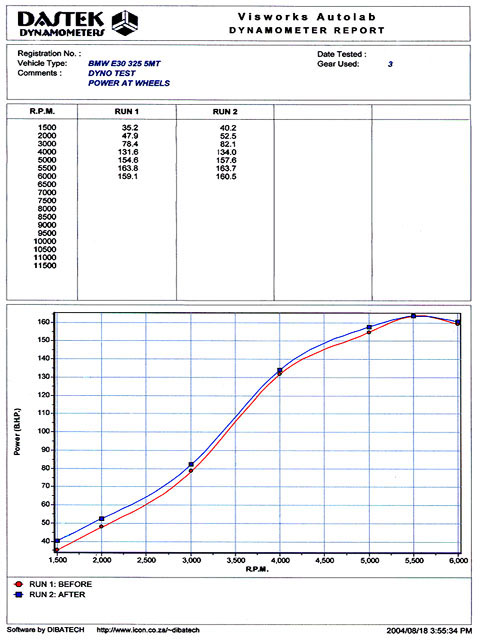
  • Power was recorder as per graph below


dynograph.jpg

[/LIST]


[Results]
  • As the dyno graph indicates, significant gains were recorded all through
    the rev range
RPM
Before
After
1500​
35.2 whp​
40.2 whp​
2000​
47.9 whp​
52.5 whp​
3000​
78.4 whp​
82.1 whp​
4000​
131.6 whp​
134.0 whp​
5000​
154.6 whp​
157.6 whp​
5500​
163.8 whp​
163.7 whp​
6000​
159.1 whp​
160.5 whp​

  • The peak power at 5500rpm drop was most probably due to heat from
    extensive dyno tests


[Verdict]
[/LIST]

  • Engine noise is now significantly lower and sounds a lot smoother
  • Engine temperature and bonnet temperature has decreased
  • Engine feels much smoother during idling
  • Engine feels much smoother during hard acceleration
  • Engine feels more powerful and smoother


Tufoil is definately worth a try, especially on older engines, it kills the
vibration and sounds especially the ticks from tappets. On newer engine, Tufoil
further protects and improves smoothness. Imagine the engine getting quieter as
you pour in and it revs much smoother. These are the noticeable initial effects.
Thumbs up!
[/LIST]


[/LIST]


Review Ends - Zerotohundred.com
 
Pls tell us where you live or work and will tell you of a Tufoil dealer nearest to you, fzavier.
 
tufoil

focal - im at Pandan Indah yang Indah2......nice sceenery, nice landscape, nice people, nice food, ...everything oso nice, including the early morning jam....kau2 one lar....
 
No need to face jam. Tufoil is available at Niew Star Auto at Shamelin Perkasa, behind German Institute. Tel: 03 92813634 Mr. Niew. Rgds.
 
Dear Tufoil Agent,

This statement doesnt mean anything to condemn/blame on your product coz I'm planning to purchase this additives also untill I found this statement on the net (lancerregister.com). Can u guys enlighten me?thanks :_:

Originally posted by oilman
No they are no good.
Have a read.
General Remarks on Chlorinated Additives.
A number of ‘add-on’ additives intended to improve the performance of commercially available automotive lubricants have been marketed in recent years, under such names as ‘Xxtralube ZX-1’, ‘Metol FX-1’, ‘PPL Anti-Friction’ and ‘Activ-8’.All such products share the following characteristics with ‘X-1R Friction Eliminator’:-
1) They all contain chlorinated paraffin ‘exteme pressure’(EP) compounds first used in the 1930s in heavily-loaded industrial gearboxes, and in some automotive transmission applications, mainly hypoid gears.
2) They all corrode copper-based alloys at moderate temperatures, easily exceeded in all engine, and most transmission applications.This problem was recognised in the 1930s, and chlorinated compounds were never used in transmissions with bronze bearings or gears. No responsible manufacturer ever suggested using them in engines where their increasing activity at high temperatures could lead to piston ring corrosion and bore glazing. (For the same reason, modern ‘hypoid’ additives are not used in engines, even though they are much safer than any chlorinated additive.)
3) X-1R Friction Eliminator and its clones are based upon very outdated technology, which was abandoned by responsible lubricant manufacturers for automotive transmission uses in the 1950s. Chlorinated compounds still find applications in metal working, but their use is on the decline because of health and safety considerations.
4) When burnt, chlorinated paraffins produce corrosive hydrochloric acid, and organo-chlorine compounds including the highly poisonous phosgene gas. Apart from these corrosion and health hazards, with petrol engines the deactivation of exhaust catalysts is also a problem.
5) Unfortunately, these additives give spectacular results in simple EP test machines such as the ‘Falex’. As a marketing ploy, a demonstration of this type looks impressive to those not aquainted with the above facts. Also attractive is the low cost of chlorinated compounds, allowing profits of several thousand percent to be made.
Cheers
Simon.
 
Tufoil is not in the same category or basket.

We reproduce here the article penned by Tufoil inventor and lubrications engineer Mr. Franklin Reick in TUFOIL NEWS Vol. 1 Sept 1993.

" There are many methods for testing lubrication oils.. each is used for a different purpose. Some tests are good for gear oils, some are good for testing cutting oils, and others are best for testing engine oils. The National Bureau of Standards ( NIST ) scientists published several papers showing that the 4 Ball test correlates with engine oil performance ( *ref. ). If another type of test was shown to be useful for this purpose, we would use it. I have seen the pin and V-block test ( the old Falex test ) used with a torque wrench on some TV informercials. An extremely misleading test. It measures EP ( extreme pressure ) characteristics of an oil only. If you want to drill holes in steel, then this is the test to use. Many lubricants that look good in this test woud be disasterous in your engine. The additives used are destructive to the rubber seals in the engine and damage the exhaust catalyst.

*Ref. Gates, R.S. and Hsu, S.M. " Development of a four-ball Wear Test. Procedure to Evaluate Automotive Engine Oils" Lubr. Eng. 39.9.
 
hi i planing to buy one bottle of tufoil yo solve my mivec tepet sound cuz i heard tufoil can solve the problem, right?? and another question is how to use the product???
 
Thanks popout for the query.

Use Tufoil together with your new motor oil during oil change. Or if your motor oil is still new at say below 1000 km of use, add in one 8 oz. bottle. But before that, make sure your dip-stick is not at the maximum mark. Do not fill oil above the max mark of your dip-stick.
 
So u mean just direct pour the tufoil into the engine to mix with engine oil right?? and the tufoil sale on Jusco on cheras selatan izzit original cost 59.90.
 
If you can get it from there, by all means. Otherwise, pls let us know your location and will recommend you a shop closest to you.
Yes, Tufoil goes into the crankcase through the engine oil filler cap.
 
ok today i just brought one bottle from Jusco but the thing inside the bottle is not liquid but in gel form a brown color gel is that normal??
 
hi bro,i m staying at subang jaya..where i can get diz product nearby?n what is the normal price.tq...
 
does it really work ?? not to say i don't put trust in this things but my engine is clocking near its 90k mark and i did saw a guy poured 1 bottle into his car during his normal engine change..its brownish n sludge-ish kind right ??? will it really get dilluted when mixed with normal engine oil ?? .. can someone show some photo of their engine dismantled after tufoil treatment ??? cz i do know of certain engine oil treatment that clogged up the passage of oil of the engine block...i meant, that sometimes, by showing pictures, its gives a better view and atleast believing that the product works rather than by word of theory and word of mouth...sorry for being very demanding because i had enough of scams where people use your mental/wallet feeling when trying something new...:biggrin::biggrin:
 
Tufoil isn't a new kid on the block. It has been around since the early '80s. There has been a following around the world ever since then. Many brands of this kind of product have come and gone. We are sure you can name them easily. Some were supposed to be so hot with expensive media advertising but eventually fell like hot potatoes.

Tip. Those numbers you see on the Tufoil packaging are the patent numbers awarded for the technology. Buy products that are properly certified and these numbers give you the clue. There is no beating about the bush and you are right ae101rulez on buying the RIGHT one and not nonsense.
 
This is for you ae101rulez.

On Feb 11, 2010, we received an sms on Tufoil and we would like to take this opportunity to reproduce it in full here for the benefit of all Tufoil users and even detractors and sceptics.

" Your tufoil already proven on my Nissan Frontier. Overhauled at 460,000 km plus. Minimum damaged and engine quite clean" Hassan Chan.

Need we say more?
 

Similar threads

Posts refresh every 5 minutes


Search

Online now

Enjoying Zerotohundred?

Log-in for an ad-less experience