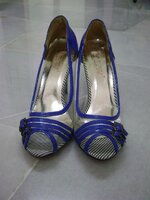

High Heels - INFORMATIVE
High-heeled shoes are shoes which raise the heel of the wearer's foot significantly higher than the toes. When both the heel and the toes are raised equal amounts, as in a platform shoe, it is generally not considered to be a "high-heel." High-heels come in a wide variety of styles, and the heels are found in many different shapes, including stiletto, block, tapered, blade, and wedge. While high heels are today mostly associated with female shoe styles, they are also found in some specialist shoe designs worn by all genders such as cowboy boots.
History of the high-heeled shoe
As early as the late fifteenth century, horsemen grew tired of their feet slipping out of their stirrups, which were little more than loops of leather hung from the saddle. As the soft stirrup gave way to the hard stirrup, for reasons of quicker mounting and dismounting during battle, an additional problem was encountered in that the hard stirrup was much more tiring and damaging to the rider's feet during longer rides.
The obvious solution was to design a leather shoe with a thicker sole that supported the rider's weight, distributing the pressure from the stirrups over more of the bottom of the rider's feet. However this failed to solve the problem of the rider's feet slipping forward in the stirrups, often with comical, if not tragic results.
Cobblers had been adding thin, flat heels to shoes by this time, as a pair of leather shoes was very expensive. Both soles and heels were developed to protect the owner's comfort and investment by increasing the long-term durability of the shoe and distributing uneven pressures from rough terrain more evenly over the owners' feet.
Riders and cobblers worked together to develop the "rider's heel," with a height of approximately 1-1/2", which appeared around 1500. The leading edge was canted forward to help grip the stirrup, and the trailing edge was canted forward to prevent the elongated heel from catching on underbrush or rock while backing up, such as in on-foot combat. These design features are still in use today in riding boots, primarily on both men and women's cowboy boots.
The simple riding heel gave way to a more stylized heel over its first three decades. During this time military uniforms became more stylized, particularly among the nobility, who equated style with social status. Beginning with the French, heel heights among men crept up, often becoming higher and thinner, until they were no longer useful while riding, but were relegated to "court-only" wear. By the late 1600s men's heels were commonly between three and four inches in height.
In 1533, more than three decades after the male French nobility began wearing heels, the diminutive wife of the Duke of Orleans, Catherine de Medici, commissioned a cobbler to fashion her a pair of heels, both for fashion, and to increase her stature. They were an adaptation of chopines, like chopines both the heel and toe were raised (not unlike modern platform shoes), but unlike what had come before, the heel was higher than the toe and the "platform" was made to bend in the middle like the foot.
http://img149.imageshack.us/img149/7628/redhighheelpumpshp4.jpg
It's been said by some that Leonardo Da Vinci was the inventor of the high-heel. While he may have designed a heel or two in his day, the truth is that it was invented due to military necessity. High-heeled shoes quickly caught on with the fashion-conscious men and women of the French court, and spread to pockets of nobility in other countries. Both men and women continued wearing heels as a matter of noble fashion throughout the seventeenth and eighteenth centuries.
When the French Revolution drew near, in the late 1700s, the practice of wearing heels drew to a close, as the term "well-heeled" had became synonymous with opulent wealth, and could incur the ire of the public at large.
Throughout most of the 1800s, flats and sandals were the normative style for both sexes, but the heel resurfaced in fashion during the late 1800s, almost exclusively among women. Since the early 1900s, high-heel design has run the gamut of styles, and heels for men saw a brief resurgence in the 1970s, as was captured by John Travolta's character in the opening and final dance sequences of Saturday Night Fever, as well as other period films. In addition to women, many transgendered people wear heels, as do a small percentage of heterosexual men. Heels are also worn today by drag queens. While today's fashions favor pointed toes, most styles that have appeared over the last century remain available in one form or another, along with a plethora of newer styles.
High-heels today
Today, high-heels are typically worn in public only by women, who may wear them on many occasions, including work, formal occasions, and during leisure activities. High-heels have seen significant controversy in the medical field lately, with many podiatrists seeing patients whose severe foot problems have been caused almost exclusively by high-heel wear.
Today's high-heels, regardless of the heel's shape, are generally limited to women's footwear. Some men's footwear, such as cowboy boots and shoes with a Cuban heel are considered by some to be a high-heel, even though neither tops 3" in the heel. What height constitutes a "high-heel" has long been a point of contention between those who wear very high-heels and those who wear lower heels. Generally speaking, a "low heel" is considered less than 1", while 1" to 2.5" heels are considered "mid heels," and anything over 2.5" is considered a "high heel". Less popular are shoes with higher heels, such as those above 4"; though in the UK during the early 1960s, the late 1970s, late 1980s and again during the late 1990s up to 2002, this was the most popular height amongst young women and fashion conscious older women. Extremely high-heeled shoes, such as those higher than 5", are effectively worn only for display, and typically for the enjoyment of shoe fetishists and/or the wearer.
There are many reasons why women desire to wear heels, including:
- the change in angle of the foot with respect to the lower leg becomes elongated, and accentuates the appearance of calves
- they change a woman's posture, pushing her chest out more and arching her back. This is known as the "animal mating" position.
- they make the woman appear taller
- they cause the wearer's legs to look longer
- they change the wearer's stride and posture, thrusting the buttocks outward and causing the hips to sway more as the wearer walks; often considered sexually alluring to men.
- some styles can reveal more of the wearer's feet, which some find sexually exciting
- Stiletto heels appear to some as either a phallic symbol or a weapon of castration.
However, many women shun high-heeled shoes because:
- they can become painful or damaging for some women's feet.
- they can shorten the wearer's stride
- they can render the wearer unable to run
As a result of these conflicting factors, women who wear high heels have a love/hate relationship with their shoes. Some women seem obsessed with high-heels, owning many pairs. Imelda Marcos, for example, was famous for her vast collection. Second-wave feminism considered high-heeled shoes a male tool of oppression meant to constrain a woman's movement (and, by metaphorical extension, social advancement) as much as possible. However, third-wave feminism advocates women wearing high heels for pleasure and, more importantly, social and capitalistic empowerment.
Throughout the last sixty years, high-heels have fallen in and out of favor several times, most notably in the late 90s, when lower heels and even flats predominated. Lower heels were preferred during the late 60s and early 70s, as well, but higher heels returned in the late 80s and early 90s. The shape of the heel has vacillated back and forth between block (70s), tapered (90s), and stiletto (50s, 80s, and post-2000).
Men and heels
Although high heels originated as male footwear around 1500, since the late 1700s, men's shoes have had primarily low heels. The two exceptions are cowboy boots, which continue to sport a taller riding heel, and a brief resurgence in higher-heeled shoes for men in the 1970s[1], depicted notably by John Travolta's opening sequence in Saturday Night Fever.
While high-heels are marketed almost exclusively to women, a small percentage of men today wear heels for various reasons, including personal preference, medical reasons, gender identity issues, and fetish roles.
Heel wear among men is especially prevalent among rock stars, which has seen many performers wearing heels, both on and off the stage since the late 1960s. This trend began with the Beatles, who wore shoes with a higher heel, but continued with many other rockers, including KISS, Lenny Kravitz, Prince, and Mötley Crüe.
The practice of men wearing heels continues to grow throughout Westernized countries including the US and Europe. This trend has not been lost on fashion designers, who have occasionally featured men wearing heels on the runways since the early 1990s. Recent changes by shoe manufacturers, including marketing more masculine styles and heels with significantly larger sizes to accommodate men, appears to underscore this trend, and many of the more masculine high-heeled shoe and boot designs that were only available in sizes up to 11 just two years ago are now available in sizes up to 13, with some in even larger sizes. The trend is prevalent enough that several online forums have existed since before 2000 which are devoted to heel wear by men. Most have between a few hundred and several thousand members.
High-heeled shoes in more feminine styles are also available in larger sizes from specialty stores, and are worn by male transvestites, crossdressers, and drag queens.
Accessories
The stiletto of certain kinds of high-heels can damage some types of floors. Such damage can be prevented by heel protectors, also called covers, guards, or taps, which fit over the "stiletto" tips to keep them from direct, marring contact with delicate surfaces, such as linoleum (rotogravure) or urethane-varnished wooden floors. Heel protectors are widely used in ballroom dancing.
Foot and tendon problems
High-heeled shoes slant the foot forward and down while bending the toes up. The more that the feet are forced into this position, the more it may cause the Achilles tendon to shorten. This may cause problems when the wearer chooses lower heels or flat-soled shoes. When the foot slants forward, a much greater weight is transferred to the ball of the foot, increasing the likelihood of damage to the underlying soft tissue which supports the foot. In many shoes, style dictates function, either compressing the toes, or forcing them together, possibly resulting in blisters, corns, hammer toes, bunions, and many other medical conditions, most of which are permanent, and will require surgery to alleviate the pain.
If it is not possible to avoid high heels altogether, then the wearer should ensure wearing high-heels no more often than twelve hours a day, and that they are spending at least a third of the time on their feet in contour-supportive "flat" shoes (such as exercise sandals), or well-cushioned "sneaker-type" shoes, saving high heels for special occasions.
One of the most critical problems of high-heeled-shoe design involves a properly constructed toebox. Improper construction here can cause the most damage to one's foot. Toeboxes which are too narrow force the toes to be "crammed" too close together. Ensuring that room exists for the toes to assume a normal separation so that high-heel wear remains an option rather than a debilitating practice, is an important issue in improving the wearability of women's high-heeled fashion shoes.
Wide heels do not necessarily offer more stability, and any raised heel with too much width, such as found in "blade-" or "block-heeled" shoes, induces unhealthy side-to-side torque to the ankles with every step, stressing them unnecessarily, while creating additional impact on the balls of the feet. Thus, the best design for a high-heel is one with a narrower width, where the heel is closer to the front, more solidly under the ankle, where the toe box provides room enough for the toes, and where forward movement of the foot in the shoe is kept in check by material snug across the instep, rather than by toes jamming together in the toe box.
Interestingly enough, despite the medical issues surrounding high-heel wear, a few podiatrists recommend well-constructed low to moderate heels for some patients. It appears a slight elevation of the heel improves the angle of contact between the metatarsals and the horizontal plane, thereby more closely approximating the proper angle and resulting in proper weight distribution of a normally-arched foot. This is one of the main reasons most Dansko clogs sport low to medium heels. Other foot specialists, however, argue that any heel causes unnecessary stresses on the various bones and joints of the foot.
High-heeled shoes are shoes which raise the heel of the wearer's foot significantly higher than the toes. When both the heel and the toes are raised equal amounts, as in a platform shoe, it is generally not considered to be a "high-heel." High-heels come in a wide variety of styles, and the heels are found in many different shapes, including stiletto, block, tapered, blade, and wedge. While high heels are today mostly associated with female shoe styles, they are also found in some specialist shoe designs worn by all genders such as cowboy boots.
History of the high-heeled shoe
As early as the late fifteenth century, horsemen grew tired of their feet slipping out of their stirrups, which were little more than loops of leather hung from the saddle. As the soft stirrup gave way to the hard stirrup, for reasons of quicker mounting and dismounting during battle, an additional problem was encountered in that the hard stirrup was much more tiring and damaging to the rider's feet during longer rides.
The obvious solution was to design a leather shoe with a thicker sole that supported the rider's weight, distributing the pressure from the stirrups over more of the bottom of the rider's feet. However this failed to solve the problem of the rider's feet slipping forward in the stirrups, often with comical, if not tragic results.
Cobblers had been adding thin, flat heels to shoes by this time, as a pair of leather shoes was very expensive. Both soles and heels were developed to protect the owner's comfort and investment by increasing the long-term durability of the shoe and distributing uneven pressures from rough terrain more evenly over the owners' feet.
Riders and cobblers worked together to develop the "rider's heel," with a height of approximately 1-1/2", which appeared around 1500. The leading edge was canted forward to help grip the stirrup, and the trailing edge was canted forward to prevent the elongated heel from catching on underbrush or rock while backing up, such as in on-foot combat. These design features are still in use today in riding boots, primarily on both men and women's cowboy boots.
The simple riding heel gave way to a more stylized heel over its first three decades. During this time military uniforms became more stylized, particularly among the nobility, who equated style with social status. Beginning with the French, heel heights among men crept up, often becoming higher and thinner, until they were no longer useful while riding, but were relegated to "court-only" wear. By the late 1600s men's heels were commonly between three and four inches in height.
In 1533, more than three decades after the male French nobility began wearing heels, the diminutive wife of the Duke of Orleans, Catherine de Medici, commissioned a cobbler to fashion her a pair of heels, both for fashion, and to increase her stature. They were an adaptation of chopines, like chopines both the heel and toe were raised (not unlike modern platform shoes), but unlike what had come before, the heel was higher than the toe and the "platform" was made to bend in the middle like the foot.
http://img149.imageshack.us/img149/7628/redhighheelpumpshp4.jpg
It's been said by some that Leonardo Da Vinci was the inventor of the high-heel. While he may have designed a heel or two in his day, the truth is that it was invented due to military necessity. High-heeled shoes quickly caught on with the fashion-conscious men and women of the French court, and spread to pockets of nobility in other countries. Both men and women continued wearing heels as a matter of noble fashion throughout the seventeenth and eighteenth centuries.
When the French Revolution drew near, in the late 1700s, the practice of wearing heels drew to a close, as the term "well-heeled" had became synonymous with opulent wealth, and could incur the ire of the public at large.
Throughout most of the 1800s, flats and sandals were the normative style for both sexes, but the heel resurfaced in fashion during the late 1800s, almost exclusively among women. Since the early 1900s, high-heel design has run the gamut of styles, and heels for men saw a brief resurgence in the 1970s, as was captured by John Travolta's character in the opening and final dance sequences of Saturday Night Fever, as well as other period films. In addition to women, many transgendered people wear heels, as do a small percentage of heterosexual men. Heels are also worn today by drag queens. While today's fashions favor pointed toes, most styles that have appeared over the last century remain available in one form or another, along with a plethora of newer styles.
High-heels today
Today, high-heels are typically worn in public only by women, who may wear them on many occasions, including work, formal occasions, and during leisure activities. High-heels have seen significant controversy in the medical field lately, with many podiatrists seeing patients whose severe foot problems have been caused almost exclusively by high-heel wear.
Today's high-heels, regardless of the heel's shape, are generally limited to women's footwear. Some men's footwear, such as cowboy boots and shoes with a Cuban heel are considered by some to be a high-heel, even though neither tops 3" in the heel. What height constitutes a "high-heel" has long been a point of contention between those who wear very high-heels and those who wear lower heels. Generally speaking, a "low heel" is considered less than 1", while 1" to 2.5" heels are considered "mid heels," and anything over 2.5" is considered a "high heel". Less popular are shoes with higher heels, such as those above 4"; though in the UK during the early 1960s, the late 1970s, late 1980s and again during the late 1990s up to 2002, this was the most popular height amongst young women and fashion conscious older women. Extremely high-heeled shoes, such as those higher than 5", are effectively worn only for display, and typically for the enjoyment of shoe fetishists and/or the wearer.
There are many reasons why women desire to wear heels, including:
- the change in angle of the foot with respect to the lower leg becomes elongated, and accentuates the appearance of calves
- they change a woman's posture, pushing her chest out more and arching her back. This is known as the "animal mating" position.
- they make the woman appear taller
- they cause the wearer's legs to look longer
- they change the wearer's stride and posture, thrusting the buttocks outward and causing the hips to sway more as the wearer walks; often considered sexually alluring to men.
- some styles can reveal more of the wearer's feet, which some find sexually exciting
- Stiletto heels appear to some as either a phallic symbol or a weapon of castration.
However, many women shun high-heeled shoes because:
- they can become painful or damaging for some women's feet.
- they can shorten the wearer's stride
- they can render the wearer unable to run
As a result of these conflicting factors, women who wear high heels have a love/hate relationship with their shoes. Some women seem obsessed with high-heels, owning many pairs. Imelda Marcos, for example, was famous for her vast collection. Second-wave feminism considered high-heeled shoes a male tool of oppression meant to constrain a woman's movement (and, by metaphorical extension, social advancement) as much as possible. However, third-wave feminism advocates women wearing high heels for pleasure and, more importantly, social and capitalistic empowerment.
Throughout the last sixty years, high-heels have fallen in and out of favor several times, most notably in the late 90s, when lower heels and even flats predominated. Lower heels were preferred during the late 60s and early 70s, as well, but higher heels returned in the late 80s and early 90s. The shape of the heel has vacillated back and forth between block (70s), tapered (90s), and stiletto (50s, 80s, and post-2000).
Men and heels
Although high heels originated as male footwear around 1500, since the late 1700s, men's shoes have had primarily low heels. The two exceptions are cowboy boots, which continue to sport a taller riding heel, and a brief resurgence in higher-heeled shoes for men in the 1970s[1], depicted notably by John Travolta's opening sequence in Saturday Night Fever.
While high-heels are marketed almost exclusively to women, a small percentage of men today wear heels for various reasons, including personal preference, medical reasons, gender identity issues, and fetish roles.
Heel wear among men is especially prevalent among rock stars, which has seen many performers wearing heels, both on and off the stage since the late 1960s. This trend began with the Beatles, who wore shoes with a higher heel, but continued with many other rockers, including KISS, Lenny Kravitz, Prince, and Mötley Crüe.
The practice of men wearing heels continues to grow throughout Westernized countries including the US and Europe. This trend has not been lost on fashion designers, who have occasionally featured men wearing heels on the runways since the early 1990s. Recent changes by shoe manufacturers, including marketing more masculine styles and heels with significantly larger sizes to accommodate men, appears to underscore this trend, and many of the more masculine high-heeled shoe and boot designs that were only available in sizes up to 11 just two years ago are now available in sizes up to 13, with some in even larger sizes. The trend is prevalent enough that several online forums have existed since before 2000 which are devoted to heel wear by men. Most have between a few hundred and several thousand members.
High-heeled shoes in more feminine styles are also available in larger sizes from specialty stores, and are worn by male transvestites, crossdressers, and drag queens.
Accessories
The stiletto of certain kinds of high-heels can damage some types of floors. Such damage can be prevented by heel protectors, also called covers, guards, or taps, which fit over the "stiletto" tips to keep them from direct, marring contact with delicate surfaces, such as linoleum (rotogravure) or urethane-varnished wooden floors. Heel protectors are widely used in ballroom dancing.
Foot and tendon problems
High-heeled shoes slant the foot forward and down while bending the toes up. The more that the feet are forced into this position, the more it may cause the Achilles tendon to shorten. This may cause problems when the wearer chooses lower heels or flat-soled shoes. When the foot slants forward, a much greater weight is transferred to the ball of the foot, increasing the likelihood of damage to the underlying soft tissue which supports the foot. In many shoes, style dictates function, either compressing the toes, or forcing them together, possibly resulting in blisters, corns, hammer toes, bunions, and many other medical conditions, most of which are permanent, and will require surgery to alleviate the pain.
If it is not possible to avoid high heels altogether, then the wearer should ensure wearing high-heels no more often than twelve hours a day, and that they are spending at least a third of the time on their feet in contour-supportive "flat" shoes (such as exercise sandals), or well-cushioned "sneaker-type" shoes, saving high heels for special occasions.
One of the most critical problems of high-heeled-shoe design involves a properly constructed toebox. Improper construction here can cause the most damage to one's foot. Toeboxes which are too narrow force the toes to be "crammed" too close together. Ensuring that room exists for the toes to assume a normal separation so that high-heel wear remains an option rather than a debilitating practice, is an important issue in improving the wearability of women's high-heeled fashion shoes.
Wide heels do not necessarily offer more stability, and any raised heel with too much width, such as found in "blade-" or "block-heeled" shoes, induces unhealthy side-to-side torque to the ankles with every step, stressing them unnecessarily, while creating additional impact on the balls of the feet. Thus, the best design for a high-heel is one with a narrower width, where the heel is closer to the front, more solidly under the ankle, where the toe box provides room enough for the toes, and where forward movement of the foot in the shoe is kept in check by material snug across the instep, rather than by toes jamming together in the toe box.
Interestingly enough, despite the medical issues surrounding high-heel wear, a few podiatrists recommend well-constructed low to moderate heels for some patients. It appears a slight elevation of the heel improves the angle of contact between the metatarsals and the horizontal plane, thereby more closely approximating the proper angle and resulting in proper weight distribution of a normally-arched foot. This is one of the main reasons most Dansko clogs sport low to medium heels. Other foot specialists, however, argue that any heel causes unnecessary stresses on the various bones and joints of the foot.