Bugatti Veyron - EXCLUSIVE

sakuraguy

5,000 RPM
Senior Member
Joined
Nov 4, 2004
Messages
5,848
Points
3,148
Location
Sendai, JAPAN.
Bugatti Veyron - EXCLUSIVE


http://img494.imageshack.us/img494/2161/logo1rn.jpg

Bugatti is one of the most celebrated marques of automobile and the one of the most exclusive Italian / French / German car producers of all time. The company is legendary for producing some of the best sports cars in the world. The original Bugatti failed with the advent of World War II, but has been resurrected twice, most recently under the Volkswagen Group.


http://img494.imageshack.us/img494/8264/founder6cc.jpg

..::Source::..
Bugatti.Co.UK
BugattiPage.Com
Wiki Group
Bugatti-Cars.DE
Car & Driver Online Magazine

Very special thanks to
Ken & Andrew
-STREETFIRE.NET-


SakuraGuy
Zerotohundred.Com​
 
Last edited:
About Bugatti

About Bugatti


Bugatti is one of the most celebrated marques of automobile and the one of the most exclusive Italian/French/German car producers of all time. The company is legendary for producing some of the best sports cars in the world. The original Bugatti failed with the advent of World War II, but has been resurrected twice, most recently under the Volkswagen Group.

Under Ettore Bugatti
Although founder Ettore Bugatti was born in Italy, the automobile company that bears his name was located in Molsheim, in the then-German Alsace region (which went back to France in 1919). The company was known for its advanced engineering in its premium road cars and its success in early Grand Prix motor racing, winning the first ever Monaco Grand Prix. The company's success culminated with driver Jean-Pierre Wimille winning the 24 hours of Le Mans twice (in 1937 with Robert Benoist and 1939 with Pierre Veyron).

Bugatti's cars were as much works of art as they were mechanical creations, with hand-turned finishes on the engine blocks, lightening holes in every conceivable location, and safety wires threaded through almost every fastener in intricately laced patterns. He regarded his arch competitor, Bentley, as "the world's fastest trucks" for turning their attentions more towards durability. Bugatti's disdain for his customers is as legendary as his devotion to his creations; in one apocryphal incident, upon greeting an unhappy customer returning to the factory with "What, you again?", he replied to the subsequent tale of automotive mechanical woe with "Well, see that it does not happen again!" and strode away.

From the shapes of his engines, he is regarded a Cubist and he once went to a meeting of Cubists.

Models
Only a few models of each of Ettore Bugatti's vehicles were ever produced, the most famous being the Type 35 Grand Prix cars, the huge "Royale", the flowing Type 57 "Atlantic", and the Type 55 sports car.

Throughout the production run of approximately 7,900 cars, each Bugatti model was designated with the prefix T for Type, which referred to the chassis and drive train.

Contract designs
-Prinetti & Stucchi
-1898 Type 1
-Dietrich-Bugatti
-1902-1904 Type 3/4
-1903 Type 5/Hermes/6/7
-Deutz Gasmotoren Fabrik
-1907 Type 8/9
-Peugeot
-1913-1916 Type 19 "Bébé"

Racing cars
-1910–1914 Type 13/Type 15/17/22
-1922–1926 Type 29
-1923 Type 32 "Tank"
-1924-1930 Type 35/35A/35B/35T/35C/37/39
-1927-1930 Type 52 (electric racer for children)
-1936–1939 Type 57G "Tank"
-1937–1939 Type 50B
-1931–1936 Type 53
-1931–1936 Type 51/51A/54GP/59
-1955–1956 Type 251

Racing success
Bugatti cars were extremely successful in racing, with many thousands of victories in just a few decades. The little Bugatti Type 10 swept the top four positions at its first race. The 1924 Bugatti Type 35 is probably the most successful racing car of all time with over 2,000 wins. The company swept the Targa Florio for five years straight from 1925 through 1929. Louis Chiron held the most podiums in Bugatti cars, and the 21st Century Bugatti company remembered him with a concept car named in his honor. But it was the final racing success at Le Mans that is most remembered—Jean-Pierre Wimille and Pierre Veyron won the 1939 race with just one car and few resources.

The end
Ettore Bugatti also designed a successful motorized railcar, the Autorail, and an airplane, but it never flew. His son, Jean Bugatti, was killed on August 11, 1939 at the age of 30, while testing a Type 57 tank-bodied race car near the Molsheim factory. After that, the company's fortunes began to decline. World War II ruined the factory in Molsheim, and the company lost control of the property. During the war, Bugatti planned a new factory at Levallois in Paris and designed a series of new cars. Ettore Bugatti died on August 21, 1947.

The company attempted a comeback under Roland Bugatti in the mid-1950s with the mid-engined Type 251 race car. Designed with help from famed Alfa Romeo, Ferrari, and Maserati designer Gioacchino Colombo, the car failed to perform up to expectations and the company's attempts at automobile production were halted.

In the 1960s, Virgil Exner designed a Bugatti as part of his "Revival Cars" project. A show version of this car was actually built by Ghia using the last Bugatti Type 101 chassis and was shown at the 1965 Turin Motor Show. Financing was not forthcoming, however, and Exner turned his attention to a revival of Stutz.

Bugatti continued producing airplane parts and was sold to Hispano-Suiza (another auto maker turned aircraft supplier) in 1963. Snecma took over in 1968, later acquiring Messier. The two were merged to form Messier-Bugatti in 1977.

Bugatti Automobili SpA
In 1987 Romano Artioli, an Italian entrepreneur, acquired the legendary Bugatti name and established Bugatti Automobili SpA. The new company built a factory designed by the architect Giampaolo Benedini in Campogalliano, Italy, a town near Modena, home to other performance-car manufacturers De Tomaso, Ferrari, Lamborghini and Maserati.

By 1989, the plans for the new Bugatti-revival were presented by Paolo Stanzani and Marcello Gandini, famous designers of the Lamborghini Miura and Countach. The first completed car was labeled the Bugatti EB110 GT, advertised as the most technically advanced supercar ever produced.

From 1992 through 1994, famed racing car designer, Mauro Forghieri, was technical director.

On August 27, 1993, through his holding company, ACBN Holdings S.A. of Luxembourg, Romano Artioli purchased the Lotus car company from General Motors. The acquisition brought together two of the greatest names in automotive racing history and plans were made for listing the company's shares for sale on international stock exchanges.

Bugatti also presented in 1993 the prototype of a large sedan called the EB 112.

By the time the EB110 came to market the North American and European economies were in recession and operations ceased in September of 1995. A model specific to the United States market called the "Bugatti America" was in the prepatory stages when the company closed.

Bugatti Automobiles SAS
Volkswagen AG purchased the rights to produce cars under the Bugatti marque in 1998. They commissioned ItalDesign to produce the Bugatti EB 118 concept, a touring sedan which featured a 555 bhp DIN (408 kW) output and the first W-configuration 18-cylinder engine on any passenger vehicle, at the Paris Auto Show.

In 1999 the Bugatti EB 218 concept was introduced at the Geneva Auto Show; later that year the Bugatti 18/3 Chiron was introduced at the IAA in Frankfurt. At the Tokyo Motor Show the EB 218 reappeared and the Bugatti EB 18/4 Veyron was presented as the first incarnation of what was to be a production road car. All had eighteen cylinders.

In 2000 Volkswagen founded Bugatti Automobiles SAS and introduced the EB 16/4 Veyron concept, a 16 cylinder car producing 1001 bhp DIN (736 kW), at the Paris, Geneva, and Detroit auto shows. Development continued throughout 2001 and the EB 16/4 Veyron was promoted to "advanced concept" status. In July of 2005 Bugatti Automobiles S.A.S. announced that the car, officially called the Bugatti Veyron 16.4, is now in production, and has been tested at a world-record 252 MPH.

It is expected that, following the Bugatti Veyron 16.4, Bugatti will produce a four-seat car with front engine, and its own unique chassis, and based on the Veyron engine and drivetrain.

Today original Ettore Bugatti cars are amongst the most sought after in the world by collectors, fetching prices as high as US$10 million.

The best-known collectors of Bugatti were Hans and Fritz Schlumpf, two brothers who ran a textiles business in Mulhouse, close to the Bugatti factory. Between 1958 and 1975 (when their business failed) they secretly amassed a remarkable collection of the cars. Now known as the Schlumpf Collection, it has been turned into one of the world's great car museums, the Musée Nationale de l'Automobile.


Source: BUGATTI INTERNATIONAL
 
Last edited:
Bugatti Veyron - EXCLUSIVE IMAGES

Bugatti Veyron - EXCLUSIVE IMAGES


http://img285.imageshack.us/my.php?image=bridge2wu.jpg
http://img285.imageshack.us/my.php?image=cockpit5bt.jpg
http://img285.imageshack.us/my.php?image=coming0xe.jpg
http://img285.imageshack.us/my.php?image=console6ln.jpg
http://img285.imageshack.us/img285/4724/parked5df.jpg

http://img285.imageshack.us/my.php?image=cover4ol.jpg
http://img285.imageshack.us/my.php?image=effect1bj.jpg
http://img285.imageshack.us/my.php?image=engine5yc.jpg
http://img285.imageshack.us/my.php?image=pose14nf.jpg
http://img285.imageshack.us/my.php?image=slide0ll.jpg

http://img285.imageshack.us/my.php?image=fast0bw.jpg
http://img285.imageshack.us/my.php?image=fullpanel4yx.jpg
http://img285.imageshack.us/my.php?image=key9gd.jpg
http://img285.imageshack.us/my.php?image=showroom7cm.jpg
http://img285.imageshack.us/my.php?image=house2cl.jpg

http://img285.imageshack.us/my.php?image=test5cz.jpg
http://img285.imageshack.us/my.php?image=run9fa.jpg
http://img285.imageshack.us/my.php?image=wallpaper4yr.jpg
http://img285.imageshack.us/my.php?image=transparent7zo.jpg
http://img285.imageshack.us/my.php?image=wing0hq.jpg

http://www.carfreaks.net/albums/bugatti_veyron/IMG_7808.jpg
http://www.carfreaks.net/albums/bugatti_veyron/IMG_7813.jpg
http://www.carfreaks.net/albums/bugatti_veyron/IMG_7820.jpg
http://www.carfreaks.net/albums/bugatti_veyron/IMG_7926.jpg
http://www.carfreaks.net/albums/bugatti_veyron/IMG_7934.jpg

http://www.carfreaks.net/albums/bugatti_veyron/IMG_7948.jpg
http://www.carfreaks.net/albums/bugatti_veyron/IMG_7952.jpg
http://www.carfreaks.net/albums/bugatti_veyron/IMG_7956.jpg
http://www.carfreaks.net/albums/bugatti_veyron/IMG_8035.jpg
http://www.carfreaks.net/albums/bugatti_veyron/IMG_8048.jpg

http://www.autorevue.cz/Images/5621/11.jpg
http://www.autorevue.cz/Images/5621/22.jpg
http://www.autorevue.cz/Images/5621/33.jpg
http://www.autorevue.cz/Images/5621/44.jpg
http://www.autorevue.cz/Images/5621/55.jpg
 
Last edited:
Bugatti Veyron 16.4

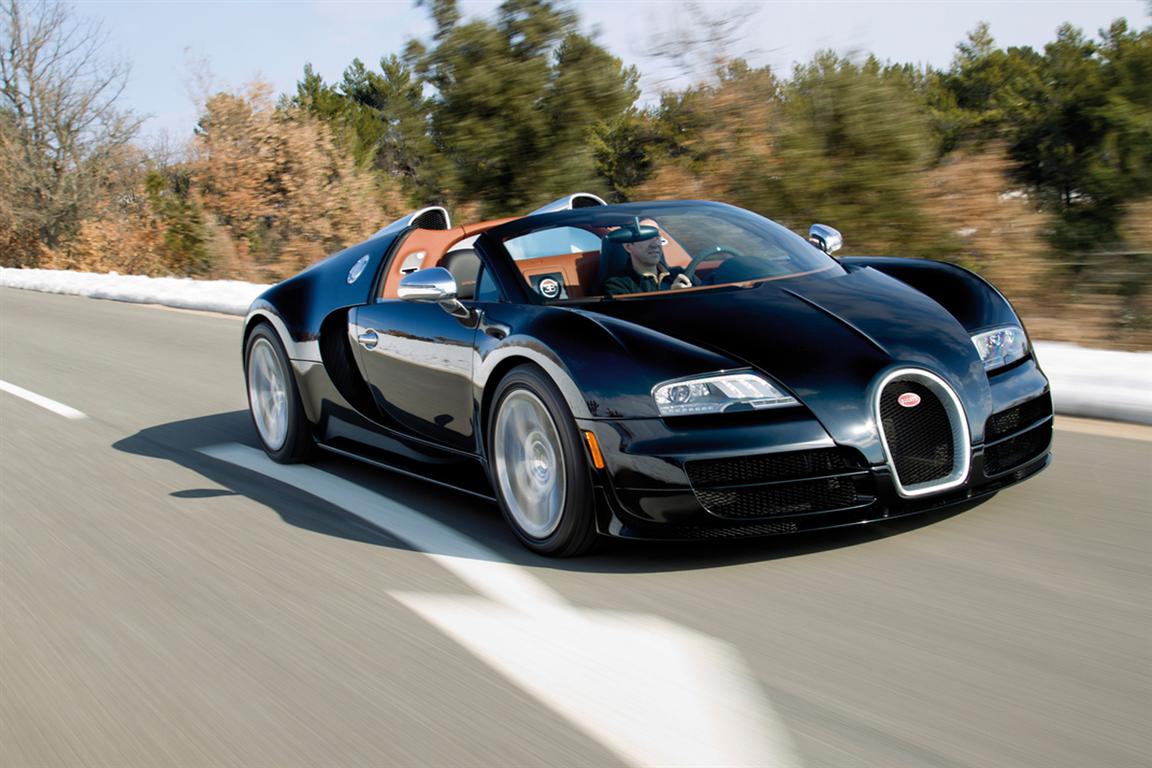
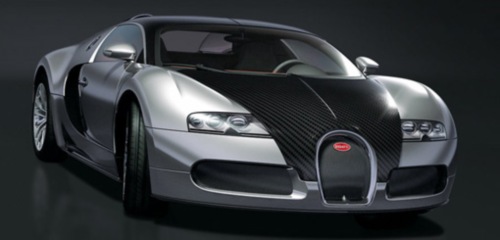
The Veyron 16.4 (known as the EB 16/4 Veyron in concept stages) is the most powerful and expensive car in the world. It reached full production in September 2005. The car is built by Volkswagen AG subsidiary, Bugatti Automobiles SAS at a production facility in Molsheim, France, and is sold under the legendary Bugatti marque. It is named for famed Bugatti racing driver, Pierre Veyron who won the 24 hours of Le Mans in 1939.

History
Development of the Veyron began with the 1999 EB 18/4 "Veyron" concept car. Introduced at the Tokyo Motor Show, it was similar in design and appearance to the final Veyron production car. One major difference was the EB 18/4's use of a W18 engine with three banks of six cylinders. The Veyron was designed by Hartmut Warkuss of Volkswagen rather than Giorgetto Giugiaro of ItalDesign who had handled the three prior Bugatti concepts.

VW chairman, Ferdinand Piëch, announced the production Veyron at the 2001 Geneva Motor Show. It was promised to be the fastest, most-powerful, and most-expensive car in history. Instead of the W18, the production model would use a VR6-style W16. First seen in the 1999 Bentley Hunaudières concept car, the W16 would get four turbochargers, producing an expected 1001 metric hp (736 kW). Top speed was promised at 406 km/h (252 mph), and pricing was announced at €1 million (US$1.3 million at the time).

Development continued throughout 2001 and the EB 16/4 Veyron was promoted to "advanced concept" status. In late 2001 Bugatti announced that the car, officially called the Bugatti Veyron 16.4, would go into production in 2003. The car experienced significant problems, however. High-speed stability was difficult, with one prototype destroyed in a crash and another spun out during a press demonstration at the Mazda Raceway at Laguna Seca. Production of the Veyron was delayed indefinitely.

Piëch retired that year as chairman of the Volkswagen Group and was replaced by Bernd Pischetsrieder. The new chairman promptly sent the Veyron back to the drawing board for major revisions. Neumann was replaced as Bugatti president by Thomas Bscher in December of 2003, and substantial modifications were made to the Veyron under the guidance of former VW engineer, Bugatti Engineering head Wolfgang Schreiber.

As of April 2005, the Veyron was expected to be released in the second half of 2005. Car and Driver visited the Bugatti factory in Molsheim in February 2005 and saw a number of cars in various stages of production, including at least one completed production model.

Specifications
The Veyron features a W16 engine—16 cylinders in 4 banks of 4 cylinders, or two W8 engines mated together in line. Each cylinder has 4 valves, for a total of 64, but the narrow W8 configuration allows two camshafts to drive two banks of cylinders so only 4 camshafts are needed. The engine is fed by four turbochargers, and it displaces 8.0 L (7,993 cm³/488 in³) with a square 86 by 86 mm bore and stroke.

Putting this power to the ground is a dual-clutch DSG computer-controlled manual transmission with 7 gear ratios. The Veyron also features full-time all wheel drive, necessary given the output of the engine. Special Michelin PAX System run-flat tires, capable of running at 253 mph (402.3 km/h), are fitted.

The car's wheelbase is 2700 mm (106.3 in). Overall length is 4466 mm (175.8 in). It measures 1998 mm (78.7 in) wide and 1206 mm (47.5 in) tall.

Performance
The W16 produces 1001 metric horsepower, equivalent to 987 SAE net horsepower or 736 kW. This easily makes it the most powerful production road-car engine in history. Torque is 1250 N·m (922 ft·lbf). According to Volkswagen, the final production Veyron engine produces between 1020 and 1040 metric horsepower (1006 to 1026 SAE net hp), so the car will be advertised as producing "1001 horsepower" in both the US and European markets.

Top speed was initially promised to be 252 mph (406 km/h), but test versions were unstable at that speed, forcing a redesign of the aerodynamics. In May, 2005, a prototype Veyron tested at a Volkswagen track near Wolfsburg, Germany, and recorded a top speed of 248.5 mph (400 km/h). The production model has now been tested and reached a top speed of 407 km/h.

The Veyron is the fastest production car to reach 100 km/h with a time of 2.5 seconds. It also reaches 200 and 300 km/h in 7.3 and 16.7 seconds respectively. This makes the Veyron the quickest-accelerating production vehicle in history. It is not the most efficient vechicle in history however, using 40.4 l/100 km in city driving and 24.1 l/100 km in combined cycle. At full-throttle, it uses up to 100 l/100 km.

Official unveiling
According to the UK magazine "Autocar", Volkswagen has officially unveiled the production version of the car (though the first units have yet to be offered for sale to the public) and published the final results of its in-house testing. The performance figures haven't yet been independently verified, if they are they will be unprecedented in a car from a major manufacturer.

The 0 to 100 km/h (62 mph) time has been announced as 2.5 seconds and the car has been measured at a two-way average top speed of 407.08 km/h (252.95 mph) at the Volkswagen Ehra Lessien test track in Germany.

The final curb-weight of the car is said to be 4,162 lb (1,888 kg) with the power output still at the 1,001 PS (736 kW) level originally promised. This is somewhat better power:weight ratio than was originally expected and may account for the increased performance figures over early prototype versions.

Bugatti plans to build 300 Veyrons over five years, the cars will be sold directly from the factory to customers but it will be possible to service them at Bentley dealerships.


Specifications

Engine
-Type: W16, Quad-Turbocharged
-Displacement cu in (cc): 488 (7993)
-Power bhp (kW) at RPM: 1001(736) / 6000
-Torque lb-ft (Nm) at RPM: 923(1250) / 2200-5500

Brakes & Tires
-Brakes F/R: ABS, vented disc/vented disc
-Tires F-R: 245/690 R520 - 335/710 R540 (PAX System)
-Driveline: All Wheel Drive

Exterior Dimensions & Weight
-Length × Width × Height in: 174.2 × 77.9 × 47
-Weight lb (kg): 4162 (1890)

Performance
-Acceleration 0-60 mph s: ~ 3 seconds
-Top Speed mph (km/h): 253 (406)
-Fuel Economy EPA city/highway mpg (l/100 km): N/A

Base Price: 2006 Bugatti Veyron 16.4 - USD$1,700,000
 
Last edited:
Fastest & Most Expensive Production Car Ever !

Bugatti Veyron 16.4 - The fastest and most expensive production car ever.


http://www.caranddriver.com/assets/image/2005/1003200512000191.jpg

When you're ripping along at 253 mph, your mind is not drifting aimlessly. Your senses are cranked up to full volume to detect any hint of impending catastrophe in the maelstrom of wind rush, tire thrum, mechanical thrash, and exhaust roar that surrounds you.

Is that slight shift in the whistling wind caused by a body panel coming loose? Does that vague vibration signal a tire starting to delaminate? Does that subtle new mechanical whine presage a failing bearing that's about to lock up the powertrain?

No such problem developed on the Bugatti Veyron 16.4, because it is not a half-baked aftermarket or boutique road burner. It is a production car developed and tested to the standards of Volkswagen, Bugatti's parent company. With a top speed of 253 mph, it is also the fastest production car ever built.

Production, of course, is a relative term. In the case of the Veyron, Bugatti plans to build only about 50 cars a year at a price of €1 million, which is about $1,250,000 as this is written. To this rarefied market Bugatti has brought an unusual level of sophistication and engineering necessitated by the promise of 1001 metric horsepower (or 987 American horses) and a top speed of 252 mph, a pledge from former VW boss Ferdinand Piëch when he unveiled the production-intent Veyron at the 2001 Geneva auto show.

Achieving 1000 horsepower in a racing engine is one thing, but to do so in a reliable, refined, durable, and emissions-legal configuration is much harder. The energizer in the Veyron is a WR16 displacing 7998cc and turbocharged with 15.8 psi of boost. You can think of it as two Passat WR8 engines put together and pumped up by four turbos.

But the Bugatti engine has more cylinders, more displacement, more power per liter, and more output overall than any other engine in the WR family tree. When I ask Bugatti development boss Wolfgang Schreiber to explain how the same engine can be rated at 1001 SAE net horsepower at 6000 rpm for the U.S. but only 987 horsepower (1001 PS) for Europe, he laughs, saying, "The production engines are all putting out between 1020 and 1040 PS—enough to cover both promises."

http://www.caranddriver.com/assets/image/2005/1003200512000411.jpg

The engine's torque peak is equally mighty at 922 pound-feet, developed between 2200 and 5500 rpm. The four small turbos minimize throttle lag, and the 9.3:1 compression ratio ensures reasonable torque even before boost develops.

All that twist required a dedicated transmission. The Veyron gets a King Kong seven-speed version of VW's twin-clutch gearbox, called DSG. Like the DSG available in the Audi TT, it operates with an automatic mode or a full manual mode via paddle shifters. Because gearchanges occur with one clutch disengaging as the other engages, shifts are uniformly smooth and swift.

With about as much engine output as two Corvette Z06 V-8s, it's no surprise that Bugatti engineers decided to go with all-wheel drive. We don't have many details about the driveline, but the front-to-rear torque split is automatically adjusted to suit dynamic conditions and can range from 100 to 0 percent at either end.

An engine—particularly a turbocharged one—that develops four-digit power throws off more heat than a dozen pizza ovens. Consequently, in the nose of the Veyron are three coolant radiators, one heat exchanger for the twin air-to-liquid intercoolers, and two air-conditioning condensers. There are also transmission and differential oil coolers on the right side and a large engine-oil cooler in the left-side air intake. To help heat escape from the engine compartment, the big WR16 sits in the open, enclosed by no cover of any kind. This powertrain propels the 4300-pound Veyron as effortlessly and gracefully as Tiger Woods belts a 300-yard drive.

My experience with the car took place at Ehra-Lessien in Germany, Volkswagen's test track and high-speed theme park not far from VW headquarters in Wolfsburg. At least it will soon become a theme park because Bugatti plans to let Veyron owners bring their cars to this 13.0-mile circuit to explore the top speed of their cars. In addition to finding out how fast the Veyron can go, I was a guinea pig for this ultimate high-speed thrill ride.

We started with two familiarization laps to get a feel for the track and the car. The track is simple, with a pair of high-banked, 150-mph corners connected by two five-mile-long straights—one of which has a slight bend so that it touches a common parking area.

With the Veyron's high beltline, I couldn't see any of the front bodywork from the driver's seat, but the view of the pavement immediately in front of the car is excellent. The driving position is comfortable, with a snug sport seat that provides great lateral support and manual fore-and-aft and seatback-angle adjustments (a plusher power seat will be optional).

Even after it was lowered to my preferred position, the steering wheel did not obstruct my view of the instrument cluster. And despite the Veyron's low, 47.5-inch height, there was plenty of clearance between my helmeted head and the headliner. Schreiber promises the car will accommodate drivers as tall as six foot seven.

Although the Veyron idles with a quiet murmur, as soon as it starts rolling you hear a symphony of mechanical music that gives way to tire thrum when you get above 100 mph, which doesn't take long. We had no opportunity to perform acceleration testing, but the ease with which the Bugatti blows past that speed is astonishing. We predict about six seconds flat from a dead stop.

What's more, the acceleration doesn't slacken when you hit triple-digit speeds. In my first lap, I took the car up to about 185 mph, at which point the tire noise was fairly loud but the Veyron was otherwise calm and relaxed. One reason it felt so secure is that when you hit 137 mph, the Bugatti hunkers down, lowering its normal ride height of 4.9 inches to 3.1 in front and 3.7 in the rear. At the same time a small spoiler deploys from the rear bodywork and a wing extends about a foot, perched at a six-degree angle. Two underbody flaps ahead of the front tires also open up. This configuration produces substantial downforce—about 330 pounds in front and 440 in the rear at 230 mph.

Given that it only takes about 500 horsepower to overcome the prevailing drag at 185 mph, that leaves the 500 horses remaining for acceleration duty. So when you plant your right foot at 185, the Veyron's surge of power shoves you into the driver's seat about as hard as a Corvette's does at 100 mph, or a Ford Five Hundred's does at 40 mph. Accelerating from 185 to 230 on my next lap didn't take very long, and the car remained glued to the pavement, although wind roar overcame tire thrumming to become the predominant sound.

But 230 mph is about as fast as the Veyron will go until you put the car into top-speed mode. This involves coming to a stop and, while the car is idling, turning a key in a lock on the floor to the left of the driver's seat. When you do that, the car sinks down even lower on its suspension, until ground clearance has been reduced to a mere 2.6 inches in front and 2.8 in the rear. This setup also causes the front underbody flaps to close and the rear spoiler and wing to retract, although the wing remains tilted out of the body at a slight two-degree angle. These changes reduce the car's drag coefficient from 0.41 to 0.36, and they reduce the peak downforce from 770 to 120 pounds.

http://www.caranddriver.com/assets/image/2005/1003200512000223.jpg

Before proceeding further, the driver is urged to verify visually that all these aerodynamic changes have taken place, as well as to check the pressure in the special Michelin PAX System Pilot Sport tires and inspect them for any damage. Developing tires that could withstand 250-plus mph while supporting up to 4800 pounds of car, occupants, and downforce was one of the major technical challenges of the Veyron, and judging by the comparative lack of concern about the tires during my run, I'd say this problem has been solved.

Beyond this suggested checklist, there are a few catches in the procedure that will make it hard to perform a top-speed run on public roads. Once the Veyron exceeds 35 mph, if you turn the steering wheel more than 90 degrees, or so much as touch the brakes, the car's configuration reverts to the handling mode.
The reasons for this became clear during my first top-speed lap. With downforce reduced, the Veyron no longer cut through the air like some hyperkinetic fastball. Instead, it meandered slightly, something akin to a swift knuckle ball.

I barely touched the car's top-speed governor that was set at 253 mph (407.5 kilometers per hour) on that first lap, but on the second I held the car there for at least three of the back straight's five miles. The combination of driveline noise, tire noise, and hurricane-force winds rushing over the car must have been deafening, but I don't remember it, as I concentrated on keeping the gently meandering car within the center of the track's three lanes.

http://www.caranddriver.com/assets/image/2005/1003200512000445.jpghttp://www.caranddriver.com/assets/image/2005/1003200511595807.jpg

The straightaway was only 32 feet wide, with a low highway-type guardrail at each edge and dense forest beyond. One stretch of the straightaway didn't even have a guardrail on the outside of the track, just a grassy embankment that sloped up at about 20 degrees for about 30 feet toward the trees. Leaving the pavement and ending up in the trees was only a twitch of the steering wheel away.

Fortunately, the Veyron's steering is ideally set up for such fast running. There's absolutely no slack on-center, and the steering responds with a gentleness that makes it easy to feed in the delicate corrections needed to keep the Veyron between the center lane's dotted lines without overcorrecting. Still, I can see why Bugatti engineers don't want their customers to be passing semis on the autobahn at 200-plus mph in this low-downforce mode.

When you lift off the throttle at 253 mph, the aerodynamic drag alone slows the Veyron at 0.3 g. After running that fast, dropping below 200 suddenly seems utterly effortless. You could not only hold a cell-phone conversation at 185 but also dial a cell phone at that pace. Allocate some money to keep an attorney on retainer if you get one of these cars, because double and triple the speed limit will quickly feel comfortable and normal.

You will likely only experience this speed in short bursts, which is why the Veyron's powerful brakes will come in handy. The car is equipped with huge carbon-ceramic brakes: 15.7 inches in front with eight-piston, four-pad calipers, and 15.0 inches in back with six-piston, two-pad calipers. When you step on the brakes at high speed, the rear wing tilts up to a 55-degree angle. At 230 mph, this increases rear downforce to 1100 pounds and adds as much as 2500 pounds of drag. A panic stop at that speed produces nearly 2.00 g of initial deceleration—at least 50 percent more retardation than a Porsche 911 can generate at any speed.
http://www.caranddriver.com/assets/image/2005/1062005124447.jpg

With the top speed verified, Schreiber jumped into the car to demonstrate the Veyron's "launch mode," which allows the engine to light up all four tires in a full-bore accel run. He promises the Veyron will sprint from rest to 100 km/h (62 mph) in less than three seconds. From this, we would conclude that the car will likely run the quarter-mile in the high 10s at about 140 mph for another production-car record.

Rational thought runs for its life when faced with the prospect of a car costing $1,250,000. But we have satisfied ourselves that the Veyron is the fastest production car ever built. We expect it to be the quickest one as well. It is strikingly attractive, beautifully finished, and brimming with sophisticated and well-developed automotive technology.

We've never driven any other car that achieves and maintains high speeds so confidently and effortlessly. Veyrons will never be commonplace and will surely be decorating the 18th fairway at Pebble Beach within the next few decades. If any automobile is worth more than a million bucks, we're happy to nominate the Veyron 16.4.

Next Up: A Bugatti to Turn a Profit

Even at $1,250,000, the Veyron is not expected to earn a dime of profit for Bugatti when development and tooling costs are counted up. But this outrageous 253-mph supercar will certainly put the Bugatti name back on the automotive map in a big way and will set the stage for future Bugatti models that will be less ambitious, less expensive, sell in higher volumes, and perhaps make money for the marque.

In an interview in the German magazine Auto Motor und Sport, Thomas Bscher, the head man at Bugatti, has conceded the Veyron is "only an investment in the marque. We will make no money from it. That must come from a new model."

http://www.caranddriver.com/assets/image/2005/1062005124427.jpghttp://www.caranddriver.com/assets/image/2005/1062005124433.jpghttp://www.caranddriver.com/assets/image/2005/1062005124440.jpg

Bscher envisioned a small Bugatti sports car—two doors, four seats—costing perhaps e100,000 ($125,000), with a production run of maybe 2000 vehicles a year. The new model "would use components from the VW Group," he added, "possibly from Bentley even, where a small car will not be competing with the Bentley cars. The new Bugatti may be fitted with a VW engine." Should such a new model arrive for 2008, Bugatti predicts the company would be making a profit the following year.

That will make for an unconventional Bugatti lineup, with one model costing about 10 times as much as the other one. It will also make Bugattis both cheaper and more expensive than the other ultra-luxury marques in the Volkswagen fold, Bentley and Lamborghini. These marketing problems will likely prove more challenging than the actual design and engineering of the new, higher-volume Bugatti.

10 Fastest Production Cars Ever

Model Year Vehicle Top Speed (mph) Source:
-2005 Bugatti Veyron 16.4 253 Car and Driver
-2005 Koenigsegg CCR 241 independent observer
-1998 McLaren F1 240 independent observer
-2003 Saleen S7 223 at 6500-rpm redline
-2004 Ferrari Enzo 220 Auto Motor und Sport
-1993 Jaguar XJ220 212 independent observer
-1992 Bugatti EB110 GT 212 Autocar
-2002 Pagani Zonda S 208 Sport Auto
-2004 Mercedes-Benz SLR McLaren 207 Auto Motor Sport
-2004 Porsche Carrera GT 207 Auto Motor und Sport

http://www.caranddriver.com/assets/image/2005/1003200512000143.jpg http://www.caranddriver.com/assets/image/2005/1003200511595859.jpg

Most cars and speeds on this list have been verified by magazine tests or other independent observers. The only exception is the Saleen S7, which we strongly suspect can achieve its sixth-gear redline at 223 mph, especially in the later turbocharged form.
 
Last edited:
How would you define the most amazing production car in the world? Would it be:

-The car with the most horsepower?
-The car with the fastest top speed and acceleration?
-The most expensive car?

At the moment, the Bugatti Veyron appears to have it all:
A W-16 engine that can produce 1,001 horsepower
A top speed of 250+ mph (400+ kph)
A 0-to-60mph time of three seconds
A 0-to-180mph time of 14 seconds

A price tag somewhere in the Euro $1 million range. In this article, we will take an in-depth look at this amazing automobile and see how it is possible to fit so much performance into a single machine. It all starts with the engine.


It All Starts With the Engine
The Bugatti Veyron is a car built around an engine. Essentially, Bugatti made the decision to blow the doors off the supercar world by creating a 1,000-horsepower engine. Everything else follows from that resolution.

http://static.howstuffworks.com/gif/bugatti-15.jpg

So let's start with the engine. How would you begin the design process for an engine this powerful? If you want to create a 1,000-horsepower engine, it has to be able to burn enough gasoline to generate 1,000 horsepower. That works out to about 1.33 gallons (5 liters) of gasoline per minute.

How much gas is that?
Here's a quick calculation, which you can ignore if you hate math:
-1,000 horsepower is equivalent to roughly 2.6 billion joules per hour. A gallon (3.8 liters) of gasoline contains 132 million joules, so a 1,000-hp engine has to be able to burn just over 20 gallons of gasoline per hour.
-However, car engines are only about one-quarter efficient -- three quarters of the gasoline's energy escapes as heat rather than as power to the wheels. So the engine actually has to be able to burn at least 80 gallons per hour, or 1.33 gallons (5 liters) per minute.
-Let's convert over to metric. Gasoline requires about 14.7 kilograms of air to burn 1 kilogram of gas. Air weighs 1.222 kilograms per cubic meter at sea level. A gallon of gasoline weighs 2.84 kilograms. So the engine has to be able to process 2.84*1.33*14.7 kilograms of air per minute, or roughly 45 cubic meters of air per minute. That's 45,000 liters of air per minute.
-If a V-8 engine is turning at 6,000 rpm, it can inhale a total of 24,000 cylinders' full of air per minute. If it needs to inhale 45,000 liters of air per minute, it works out to roughly 2 liters per cylinder-full. That's a 16-liter engine.

We need a 16-liter engine to burn 1.33 gallons of gas per minute. That actually makes sense -- the engine in the Dodge Viper is 8.0 liters in displacement and produces 500 hp.

But there's a problem: A 16-liter V-8 engine would be very large. And the pistons would be massive, so there would be no way it could turn at 6,000 rotations per minute (rpm). It might turn at a maximum of 2,000 rpm, meaning that you would need an immense 48-liter engine to generate 1,000 hp. Clearly an engine that big is impossible in a passenger car.


The Engine: Creating the Magic
Bugatti did two things to create a compact engine capable of producing 1,000 hp. The first and most obvious thing is turbocharging.

You know that one easy way to make an engine more powerful without making the engine bigger is to stuff more air into the cylinders on each intake stroke. Turbochargers do that. A turbo pressurizes the air coming into the cylinder so the cylinder can hold more air.

If you stuff twice as much air in each cylinder, you can burn twice as much gasoline. In reality, it's not quite a perfect ratio like that, but you get the idea. The Bugatti uses a maximum turbo boost of 18 PSI to double the output power of its engine.

Therefore, turbocharging allows Bugatti to cut the size of the engine from 16 liters back down to a more manageable 8 liters.

To generate that much air pressure, the Bugatti requires four separate turbochargers arranged around the engine.

The second thing Bugatti engineers did, both to keep the RPM redline high and to lower lag time when you press the accelerator, was to double the number of cylinders. The Bugatti has a very rare 16-cylinder engine.

There are two easy ways to create a 16-cylinder engine.

One way would be to put two V-8 engines in-line with each other. You connect the output shaft of the two V-8s together.
Another would be to put two in-line 8-cylinder engines beside one another.
The latter technique is, in fact, the way Bugatti created its first 16-cylinder cars in the early 20th century.
For the Veyron, Bugatti chose a much more challenging path. Essentially, Bugatti merged two V-8 engines onto one another, and then let both of them share the same crankshaft. This configuration creates the W-16 engine found in the Veyron. The two V's create a W.

There is a fantastic video available on the 1,000 horsepower W-16 engine that powers the Bugatti Veyron. However, it is not easy to find it and it is not possible to link to it directly. Here's directions on how to get there:

-Go to www.bugatti-cars.de
-Choose "English".
-Along the top, click on "Models"
-Choose "Veyron 16.4"
-Choose "Engineering"
-Choose "Engine"
-Along the bottom, choose "Legends from 1001 HP"

Click on video segments 1 through 7 in sequence. You may have to click the play button (small arrow) to get them to play initially.

Then, Bugatti started piling on features to make the engine even better.


The Engine: Special Features
The special features of the Bugatti W-16 engine are amazing. For example: The engine has four valves per cylinder, for a total of 64 valves.

It has a dry sump lubrication system borrowed from Formula 1 race cars, along with an intricate internal oil path to ensure proper lubrication and cooling within the 16 cylinders.
It has electronically controlled, continuously variable cam timing to create optimal performance at different engine rpm settings.

It has a massive radiator to deal with all of the waste heat that burning 1.33 gallons of gasoline per minute can generate.

Everything about the engine is superlative.

And it is remarkably compact. It measures just 710 mm (27 inches) long, 889 mm (35 inches) wide and 730 mm (28.7 inches) high. This is the beauty of Bugatti's W-16 approach the engineers managed to fit 1,000 hp into a reasonably sized package.

In order to harness all of this horsepower and torque, you need an amazing transmission.


The Transmission
The transmission is unique, in particular because it has to harness about twice as much torque as any previous sports-car transmission. It has:

-Seven gears
-A dual clutch system
-Sequential shifting

A paddle-driven, computer-controlled shifting system
This computer-controlled system is identical to the sort of system found in a Formula 1 car or a Champ car. There is no clutch pedal or shift lever for the driver to operate -- the computer controls the clutch disks as well as the actual shifting. The computer is able to shift gears in 0.2 seconds.


The Tires
Even the tires for the Veyron are unique. They're specially designed by Michelin to handle the stress of driving at 250 mph. The tires need to be sticky like a race car's and able to handle 1.3 G's on the skidpad. However, they also need to last longer than the 70 or so miles of a typical race tire.
Michelin therefore created completely new tires to handle the Veyron's unique requirements. In the rear, the tires are 14.4 inches (36.6 cm) wide. Specifically, the tires measure 245/690 R 520 A front and 365/710 R 540 A rear, where 245 and 365 are the width in millimeters (9.5 and 14.4 inches respectively). The rims are 520 mm and 540 mm in diameter (approximately 20 inches). These tires, in other words, are massive the rears are the widest ever produced for a passenger car.

The tires use the Michelin PAX system. Their pressure is monitored automatically, and they can run flat for approximately 125 miles (201 km) at 50 mph (80 kph). According to Michelin, the run-flat detection system "plays an integral role in active safety in PAX System. Its role is to inform you of a loss of pressure, either gradual or sudden." Once warned of an air leak by the PAX system, you can reduce your speed and head toward a tire repair center.


The Body
According to one of the Veyron's designers, the biggest challenge in creating the Veyron was the aerodynamics. How do you keep a 250-mph passenger car on the road?

An F-1 car or a Champ car can travel at 250 mph or more, but they have a uniquely designed body, a single driver lying in a reclining position, just an inch or so of ground clearance and an aero-package made up of large wings to generate massive downforce. The Bugatti, on the other hand, is trying to look like a normal car and seat two passengers.

The Veyron's dimensions help to some extent. The car is 79 inches (200 cm) wide, 176 inches (447 cm) long and only 48 inches (122 cm) high. Keep in mind that a Hummer 2 is 81.2 inches wide. The Bugatti is extremely wide for its height.

http://static.howstuffworks.com/gif/bugatti-14.jpg

The underside of the Veyron, like an F-1 car, is streamlined and venturi-shaped to increase downforce. There is also a wing in the back of the Veyron (see below) that extends automatically at high speed to increase downforce and keep the car glued to the road. According to Popular Science: Hypercar, "With the moving tail spoiler we've got enough downforce now, about 100 kg (221 pounds) at the rear and 80 kg (177 pounds) at the front at top speed."

http://static.howstuffworks.com/gif/bugatti-7.jpg

If you look at the above photo, you'll notice two snorkel-like devices, one on either side of the engine, on the roof of the car. The Veyron uses these to manage airflow. The Veyron has three reasons for managing airflow:

-At maximum power, the engine is consuming 45,000 liters of air per minute.
-At maximum power, the engine is burning 1.33 gallons of gasoline per minute and needs to dissipate all of that heat through its radiators.
-When stopping, the brakes need to dissipate heat –- especially important when rapidly accelerating and braking on twisty road courses.
-You can see how the Veyron handles these requirements in the photo below. The engine of the Veryon sits behind the driver, so roof-mounted snorkels, the rear-deck vents and side-mounted scoops bring air to the engine and rear brakes.

The size of the engine and transmission, along with the four-wheel-drive system and the four drive shafts, along with the opulence of the passenger compartment (discussed in the next section) and the car's oversized dimensions, all add weight. Even though the body is sculpted in carbon fiber to minimize its mass, the car weighs in at about 4,300 pounds (1,950 kg). For comparison, a Dodge Viper weighs about 1,000 pounds (454 kg) less.

Speaking of the opulent interior.


The Interior
The Veyron seats two in lavish style. The interior is swathed almost completely in leather the dash, seats, floor and sides are all leather. Only the instruments and a few metal trim pieces interrupt the leather experience.

http://static.howstuffworks.com/gif/bugatti-12.jpg

The car also surrounds its occupants with every sort of electronic nicety, including a remarkable stereo system, navigation system, etc.

Is all of this worth a million bucks? Who knows. But regardless, the Veyron represents a remarkable technological achievement.

The Veyron is also likely to represent the far end of the automotive performance spectrum for some time to come. To create a car much faster will require adding even more weight, and delivering even more power to the wheels. The added weight means diminishing returns in the power-to-weight domain. Additional power means more wheelspin.

http://static.howstuffworks.com/gif/bugatti-13.jpg

Look at a Champ car and consider how radical its appearance is compared to a passenger car. Consider also that a Champ car does not go much faster than the Veyron. The Veyron probably approaches the outer limits of the passenger car envelope, and we are unlikely to see much beyond the Veyron in terms of performance.

This is, in other words, as good as it gets.

 
Last edited:
Bugatti Veyron Video's

Some Videos Of Bugatti Veyron, The Ultimate Street Car!
-http://video.sport1.de/pub/Video/msmedia/de/Motorvision/Motorvision/mv54-bugati1_wmt_adsl.asf
-http://video.sport1.de/pub/Video/msmedia/de/Motorvision/Motorvision/mv54-bugati2_wmt_adsl.asf
-http://www.koenigsegg.com/movies/Web_NardoWeb5031816.wmv
-http://www.autoaddiction.net/viewers/fileDetails.php?content_id=282&parent_category_name=Videos
-http://autos.msn.com/as/pebblebeach2003/asx/BugattiVeyron_300.asx
 
Last edited:

Similar threads

Posts refresh every 5 minutes


Search

Online now

Enjoying Zerotohundred?

Log-in for an ad-less experience