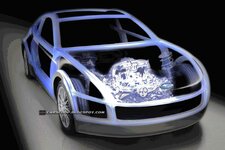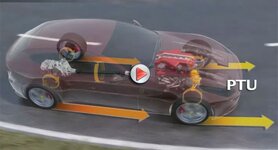
1) Every Subaru has a boxer engine. And this engine is used for one main reason - performance.
In a boxer engine, the cylinders are horizontally opposed. When you look straight down on the engine, the pistons look like a boxer's fists going back and forth towards the other pistons, one side against the other. In most engines, such as in-line or "V" engines, the cylinders are set vertically. What difference does it make? Quite a bit, when it comes to handling.
The high-power Subaru boxer engine is ideal for an All-Wheel Drive application because it's inherently compact - short and low. The layout concentrates its mass in a small area and contributes to a lower center of gravity.
Mounting the boxer engine longitudinally (front to back) allows the transmission to be mounted directly behind it. Power travels in a straight, near-horizontal line to the rear differential, minimizing frictional loss. This symmetrical, uniform layout also provides excellent left-right balance.
All of this means that the car has increased stability through turns, superior control and less susceptibility to body roll when cornering. Not only is it safer, it just feels more stable when you drive it.
-----------------------------------------------------------------------------------------------
2) Subaru's concept of total safety performance support driving pleasure. The core technologies at the heart of this approach are the Horizontally-Opposed Engine and Subaru's AWD system, which delivers superior balance with its left/right symmetrical layout. In addition, Subaru has added new features to improve visibility and operability and has improved collision safety through a range of innovations.
-----------------------------------------------------------------------------------------------
3) Subaru models equipped with the four-speed electronic automatic transmission (4EAT) employ Active All-Wheel Drive. Active All-Wheel Drive optimizes power distribution before slippage occurs.
Instead of a viscous coupling center differential, 4EAT-equipped Subaru vehicles feature an electronically managed variable transfer clutch in the transaxle tail shaft. Power transfer is governed by slippage in the clutch plates, which use a special friction material that easily handles the loads generated during power transfer.
The electronic Transmission Control Module (TCM) controls the All-Wheel Drive multi-plate clutch. The "normal" power split is 90 percent front/10 percent rear. The active AWD can adjust the power split in an instant, depending on the various input factors. If the front wheels begin to slip, the TCM increases hydraulic pressure on the clutch, reducing slippage of the plates. As the front wheels regain traction, the TCM reduces pressure on the clutch, increasing slippage of the plates and transferring power to the front.
Variable Torque Distribution (VTD) All-Wheel Drive is the most advanced All-Wheel Driving system that Subaru has ever offered. VTD works in conjunction with the Subaru VDC system to provide unequalled traction and stability. Under normal conditions, VTD splits power 45% to the front wheels and 55% to the rear wheels to deliver better performance driving.
-----------------------------------------------------------------------------------------------
4) With Active All-Wheel Drive, the TCM monitors input from speed sensors on the front and rear output shafts and also takes input from the throttle position and transmission. All of these factors cause the TCM to choose how aggressively it adjusts the power split.
Subaru Active All-Wheel Drive varies the power split according to how and where you drive the car. Under acceleration, weight transfers to the rear, and the system responds by transferring more power to the rear wheels (in a front-wheel drive car, this weight transfer on acceleration can cause wheel spin, compromising traction). When braking, weight transfers to the front of the vehicle, and the All-Wheel Driving system transfers power to the front wheels to help reduce stopping distance.
Compared with standard front- or rear-wheel drive, All-Wheel Drive also enhances cornering performance. When you enter a turn, lifting off the gas and applying the brake transfers power to the front wheels for greater steering control. As you exit the turn and accelerate, power transfers to the rear wheels for added traction under acceleration. Power transfer occurs quickly and imperceptibly, just as it does with the continuous AWD in a manual-transmission.
Because wheel speed differences occur in normal driving – not just slippery conditions – Subaru made active All-Wheel Drive intelligent. A front/rear wheel speed difference of up to 20 percent tells the TCM that the car is simply cornering. Any difference greater than 20 percent will signal true front-wheel slippage and the TCM then transfers power to the rear.
-----------------------------------------------------------------------------------------------
- Need more comment from Drivers of Subaru (Impreza) to verify and validate comments above - thanks
In a boxer engine, the cylinders are horizontally opposed. When you look straight down on the engine, the pistons look like a boxer's fists going back and forth towards the other pistons, one side against the other. In most engines, such as in-line or "V" engines, the cylinders are set vertically. What difference does it make? Quite a bit, when it comes to handling.
The high-power Subaru boxer engine is ideal for an All-Wheel Drive application because it's inherently compact - short and low. The layout concentrates its mass in a small area and contributes to a lower center of gravity.
Mounting the boxer engine longitudinally (front to back) allows the transmission to be mounted directly behind it. Power travels in a straight, near-horizontal line to the rear differential, minimizing frictional loss. This symmetrical, uniform layout also provides excellent left-right balance.
All of this means that the car has increased stability through turns, superior control and less susceptibility to body roll when cornering. Not only is it safer, it just feels more stable when you drive it.
-----------------------------------------------------------------------------------------------
2) Subaru's concept of total safety performance support driving pleasure. The core technologies at the heart of this approach are the Horizontally-Opposed Engine and Subaru's AWD system, which delivers superior balance with its left/right symmetrical layout. In addition, Subaru has added new features to improve visibility and operability and has improved collision safety through a range of innovations.
-----------------------------------------------------------------------------------------------
3) Subaru models equipped with the four-speed electronic automatic transmission (4EAT) employ Active All-Wheel Drive. Active All-Wheel Drive optimizes power distribution before slippage occurs.
Instead of a viscous coupling center differential, 4EAT-equipped Subaru vehicles feature an electronically managed variable transfer clutch in the transaxle tail shaft. Power transfer is governed by slippage in the clutch plates, which use a special friction material that easily handles the loads generated during power transfer.
The electronic Transmission Control Module (TCM) controls the All-Wheel Drive multi-plate clutch. The "normal" power split is 90 percent front/10 percent rear. The active AWD can adjust the power split in an instant, depending on the various input factors. If the front wheels begin to slip, the TCM increases hydraulic pressure on the clutch, reducing slippage of the plates. As the front wheels regain traction, the TCM reduces pressure on the clutch, increasing slippage of the plates and transferring power to the front.
Variable Torque Distribution (VTD) All-Wheel Drive is the most advanced All-Wheel Driving system that Subaru has ever offered. VTD works in conjunction with the Subaru VDC system to provide unequalled traction and stability. Under normal conditions, VTD splits power 45% to the front wheels and 55% to the rear wheels to deliver better performance driving.
-----------------------------------------------------------------------------------------------
4) With Active All-Wheel Drive, the TCM monitors input from speed sensors on the front and rear output shafts and also takes input from the throttle position and transmission. All of these factors cause the TCM to choose how aggressively it adjusts the power split.
Subaru Active All-Wheel Drive varies the power split according to how and where you drive the car. Under acceleration, weight transfers to the rear, and the system responds by transferring more power to the rear wheels (in a front-wheel drive car, this weight transfer on acceleration can cause wheel spin, compromising traction). When braking, weight transfers to the front of the vehicle, and the All-Wheel Driving system transfers power to the front wheels to help reduce stopping distance.
Compared with standard front- or rear-wheel drive, All-Wheel Drive also enhances cornering performance. When you enter a turn, lifting off the gas and applying the brake transfers power to the front wheels for greater steering control. As you exit the turn and accelerate, power transfers to the rear wheels for added traction under acceleration. Power transfer occurs quickly and imperceptibly, just as it does with the continuous AWD in a manual-transmission.
Because wheel speed differences occur in normal driving – not just slippery conditions – Subaru made active All-Wheel Drive intelligent. A front/rear wheel speed difference of up to 20 percent tells the TCM that the car is simply cornering. Any difference greater than 20 percent will signal true front-wheel slippage and the TCM then transfers power to the rear.
-----------------------------------------------------------------------------------------------
- Need more comment from Drivers of Subaru (Impreza) to verify and validate comments above - thanks